
Capital Allocation & Valuation6 min read
aude’s Workplace Push Puts Microsoft’s Copilot Renewals to the Test
Claude now has workplace tools of its own, including spreadsheets. Companies can keep Microsoft 365 while moving part of their AI budget to Anthropic.

file, two ways to charge
On November 10, Anthropic introduced new workplace tools. In Claude Sheets, users can create and edit spreadsheets and collaborate with colleagues inside Claude. Claude was already available in some Microsoft 365 workflows. Native spreadsheets let users complete some work that would previously have started in Office. The first revenue at risk may be the Copilot licenses customers drop at the next renewal. Claude Sheets · The Information · Anthropic on Microsoft integrations
An Office renewal often pays for email, identity, permissions and compliance alongside apps. An employee trying a spreadsheet elsewhere rarely triggers an enterprise migration. A cheaper move for the CFO is to renew the suite and reserve AI licenses for frequent users. If procurement can support both tools, the contest is for the marginal AI dollar, beyond who opens more spreadsheets.
On October 28, Microsoft reported 17% year-over-year Microsoft 365 Commercial cloud revenue growth for the September quarter, or 18% in constant currency. That predates the launch and covers a broader bundle. It does not isolate Copilot attach rates, churn at renewal or substitution by Claude. Use it as a starting point, with the chronology in view. Microsoft results
Availability also shapes the competitive effect. Anthropic documents Claude Sheets as a beta, with administrators enabling it on enterprise plans. Individuals may like a new spreadsheet while IT delays rollout for retention, permissions or procurement reasons. To measure substitution, ask how much of the organization can actually access the product and which work it is allowed to handle. Claude enterprise availability
el AI attach before Office seats
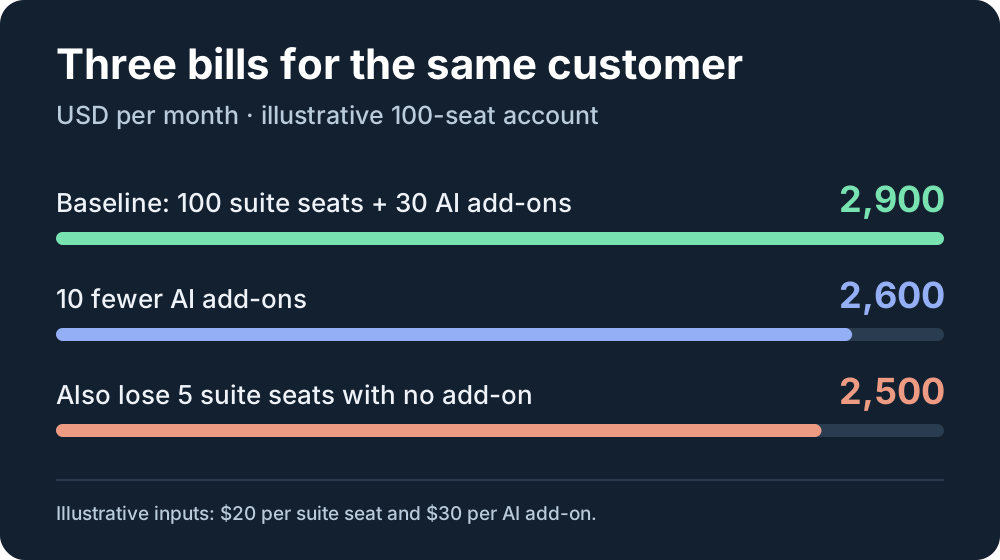
Take a 100-person customer paying $20 per person per month for the suite. Thirty people pay $30 more for AI. Monthly revenue is $2,900. If the customer keeps just 20 AI add-ons at renewal and all 100 suite seats, revenue falls to $2,600, down about 10.3%. Suite renewal can be 100% while this account shrinks. The numbers are illustrative, not Microsoft contract terms.
Now remove five seats that had no AI add-on. The suite loses $100 and AI add-ons lose $300, for $400 combined. The 95 remaining seats would need a net increase of about $4.21 per seat per month to close the gap, roughly 21% of the original suite price. If the increase comes with more AI usage, deduct inference and sales concessions before comparing cash contribution.
There is another path that headline disclosures can obscure. A customer may keep all 30 add-ons and all suite seats but demand a concession at renewal. Customer and seat counts can stay flat while contract value declines. Conversely, integrating Claude into Microsoft workflows could preserve the default customer relationship even when outside models handle some inference. Investors should then ask what those models cost to serve and what cash the retained relationship earns.
Put each customer on its own baseline. Losing ten add-ons means different things at accounts that started with 30 and 300. A company-level model should weight renewal dates, attach rates and contract sizes. Following only teams that eagerly try new tools overstates substitution. Following only the biggest, slowest-moving customers can miss earlier changes among smaller businesses.
kflow migration moves slower than trial
A scratch spreadsheet can move easily. A monthly workbook signed off by finance, audit and the business may depend on permissions, formulas, macros, data connections, approvals and retention. Track experiments, recurring workflows and formal delivery separately. Activity in the first bucket shows appeal. Sustained use in the other two gives better evidence that workflows and budgets are moving.
A Buffett-style pricing-power test fits here. Ask what customers still renew after prices rise. Willingness to pay for governance and integrations supports the value of Microsoft’s suite. If a headline price increase requires larger bundle discounts to hold renewals, list prices reveal little. The same test applies to Anthropic. Trial volume becomes durable revenue only when customers keep work worth paying for in its tools.
ate valuation with renewal evidence
Watch three items: AI license renewals and attach counts, effective suite pricing and paid seats, and contribution after incremental AI serving costs. Filings may not give all three. Earnings Q&A, public procurement terms and documented customer migrations can help. One quarter tells little about the long run when contracts renew on staggered schedules.
Active users are easy to misread. More weekly Copilot users do not establish that customers pay for more people if bundled access expands. Conversely, even with flat paid seats, concentrating usage among power users can increase serving costs without higher subscription revenue. Give activity, paid adoption and unit cost their own assumptions.
Read how AI changes SaaS seat pricing
Start with two variables: what existing customers pay for AI and how much suite revenue Microsoft retains. Model retention, suite pressure and mixed-tool adoption, without extrapolating revenue from tool usage. If Copilot attach slows while Office seats hold up, change the AI revenue curve first. Sustained evidence on effective price, seats or workflow migration can change the suite’s long-run cash flows. Open Valuefocus Reverse DCF
Sources and photo credits
Recent posts






















































Test the cash-flow assumptions from the article in Valuefocus.
Open Reverse DCF