
Enterprise Software, Buyouts and ValuationAbout 11 minutes
Silver Lake Wants Workday: Is AI Killing SaaS—or Exposing a Mispriced Cash Machine?
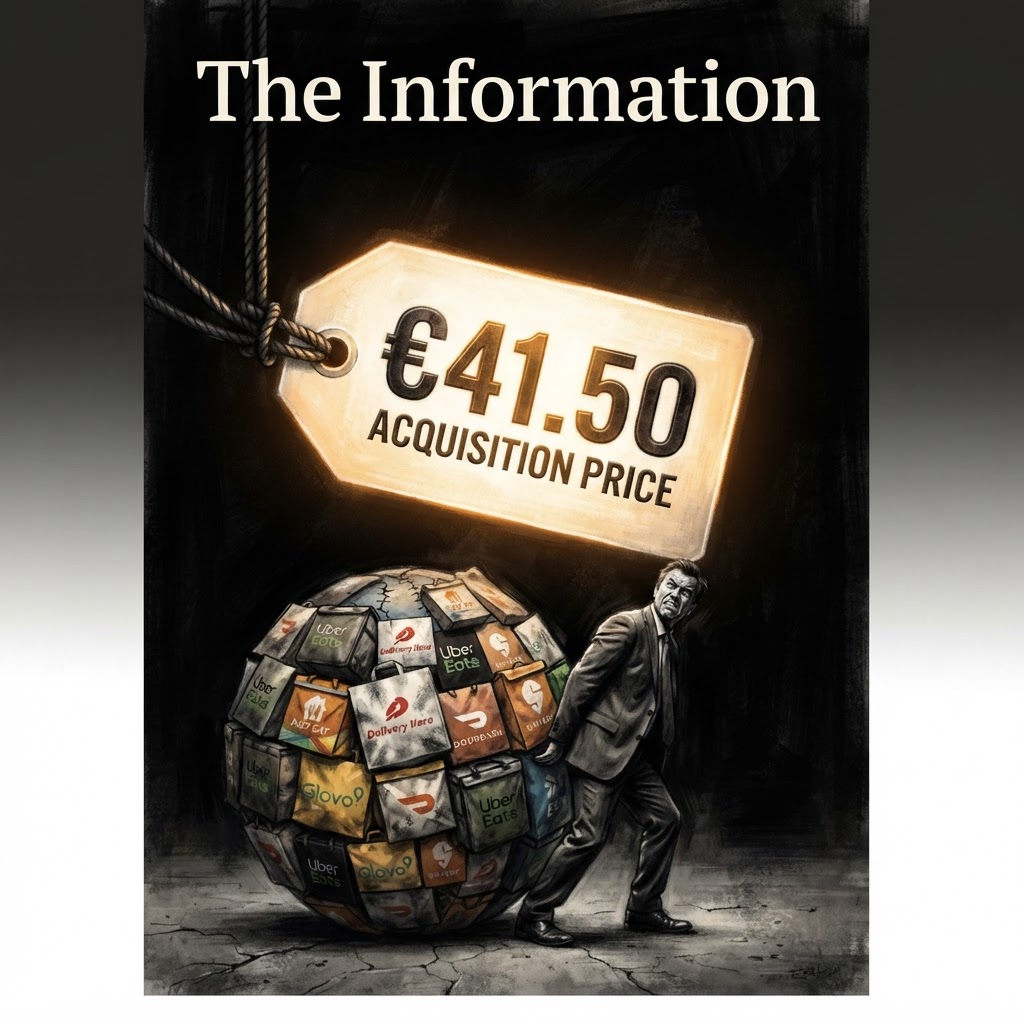
A takeover report lifted Workday 18% and moved its equity value from roughly $43 billion to $51 billion. Silver Lake may be betting on $28.1 billion of subscription backlog and extreme switching costs. But Workday’s $2.78 billion of free cash flow also contains $1.63 billion of stock compensation.

An 18% Jump Is Not an 18% Increase in Facts
Reuters reported on August 13 that Silver Lake was in talks to acquire Workday in what could become one of the largest software buyouts. The Information recorded the 18% jump, while Axios put the pre-report value near $43B and the post-report value near $51B.
Talks are not a bid. No public per-share price, debt commitment, equity consortium, board approval or signed agreement exists. At $198.68 on August 17, the market was pricing a probability tree rather than a locked cheque.
Merger-arbitrage discipline separates standalone value, deal probability, potential premium and failure downside. Treating $206.45 as guaranteed consideration disguises a probability judgment as a fact.
| Confirmed | Unknown | Valuation meaning |
|---|---|---|
| Talks reported; stock rose 18% | Price, financing, signing | Market price includes probability |
| $43B pre-report value | Standalone failure value | Model a no-deal case |
| $51B post-report value | Control premium | A rally is not a margin of safety |
Private Equity Is Buying a $28.1B Migration Barrier
Workday’s FY2026 10-K shows $9.55B of revenue, $8.83B of subscription revenue and $28.10B of total subscription backlog. More than 11,500 organizations use it, including over 65% of the Fortune 500.
Payroll, identity, organizational structures, close processes and permissions are systems of record. Replacement means cleansing data, rebuilding integrations, retraining employees, passing audits and accepting payroll or tax failure risk. Customers buy avoided migration risk as much as features.
AI can cheapen interfaces and workflow generation while increasing the value of trusted master data. The moat breaks only if agents can move the data and accountability layer away from Workday—not merely write a better chatbot.
Growth Did Not Vanish; It Became an LBO Asset
FY2027 Q1 revenue rose 13.5% to $2.54B, subscription revenue rose 14.3% to $2.35B and 12-month backlog rose 15.5% to $8.81B. Management kept its $9.925B–$9.950B subscription outlook and raised non-GAAP margin guidance to 30.5%.
This is not a melting ice cube, but it is no longer a 30%-growth SaaS stock. Silver Lake’s contrarian case may be that public markets are penalizing deceleration after backlog visibility and margin expansion have already made Workday financeable.
An August 17 TikHub pull on “Workday Silver Lake” clustered around whether open source lowers software costs, whether systems of record resist AI better than front ends, and whether 21,070 employees represent restructuring capacity. Missing engagement data makes it a controversy radar, not a ranking.
| Metric | Result | Meaning |
|---|---|---|
| FY2026 subscription revenue | $8.83B, +14% | Still double-digit growth |
| FY2026 total backlog | $28.10B, +12% | About 3.2x annual subscription revenue |
| Q1 non-GAAP margin | 31.8% | Visible operating leverage |
| Customers using native agents | More than 4,000 | AI can become an upsell channel |

Why the 5.4% Free-Cash-Flow Yield Is Half a Truth
FY2026 operating cash flow was $2.94B and free cash flow $2.78B. At $51B of equity value, that is 18.4x FCF or a 5.4% yield. Adding $3B of debt and subtracting $5.44B of cash gives roughly $48.6B of enterprise value, or 5.1x revenue.
But cash flow adds back non-cash stock compensation. Workday recorded $1.63B of it, 17% of revenue. If equity awards are a recurring cost of retaining engineers and salespeople, the payment medium does not make the economics disappear.
Subtracting all SBC leaves $1.15B. That is a deliberately severe dilution-adjusted stress test, not GAAP owner earnings: it ignores timing and tax differences. It still exposes the LBO question—after going private, employees must be paid in cash, options or sponsor equity.
Buybacks Are Not a Free Dilution Eraser

Munger’s inversion: follow every dollarStart with who ultimately owns the cash, not adjusted profit
- Stock compensation: $1.63B in FY2026 and $409M in Q1 FY2027, still 16.1% of quarterly revenue.
- Buybacks: $2.89B bought 12.77M shares at $226.62; total shares fell by only about 7.22M, showing that issuance absorbed part of the program.
- Price discipline: $198.68 on August 17 was about 12% below the FY2026 average repurchase price. A buyback is capital allocation, not proof of value.
Silver Lake Can Rewrite the Cost Contract, Not the Revenue Contract
The classic PE script is to leverage recurring cash flow, then improve cost, pricing, product mix and capital structure. Workday spent $2.68B on R&D and $2.62B on sales and marketing in FY2026 and employed 21,070 people. A few margin points are meaningful dollars.
Yet cuts are reflexive. Reducing R&D and service can lift near-term cash while weakening Workday’s ability to defend the record layer with AI. Replacing stock pay with cash makes adjusted margin converge toward economic cost. Raising prices creates a migration incentive for Oracle, SAP and AI-native rivals.
The intelligent play separates growth capital from maintenance capital: protect identity, permissions, master data and agent governance; remove duplicative selling, low-return acquisitions and products that do not improve retention.
Founder Control Is the Off-Balance-Sheet Deal Liability
Class B shares carry ten votes each versus one for Class A. At January 2026, David Duffield and affiliates controlled about 39M Class B shares and Aneel Bhusri about 8M. A change of control also requires a separate majority vote of Class B.
Silver Lake therefore cannot win with a public-market premium alone. It must persuade founders that private ownership protects product, people and customer trust—or pay for control and foregone upside. Dual-class stock is a governance discount in normal markets and a veto right in M&A.
A Graham-style investor strips rumor premium from base value. If talks fail, shareholders own a 14%-growth company with SBC at 17% of revenue and debatable buyback discipline. If they succeed, upside becomes capped by the bid and time to close.
Three Master Lenses
Buffett: test pricing power and retention, not the number of AI features. Backlog and migration risk are attractive; persistent SBC reduces owner economics.
Howard Marks: consensus says AI kills SaaS. Second-level thinking separates commodity interfaces from systems controlling master data and accountability. The 18% rumor rally has already sold part of that insight.
Damodaran: force the story into renewal, backlog, revenue per customer, AI upsell and dilution. If growth falls to 8%, margins stall and SBC stays near 16% of revenue, a large control premium needs more leverage to work.
Reverse the Valuation Instead of Guessing the Bid
Use two cash-flow anchors: reported $2.78B FCF and the severe $1.15B after-SBC stress proxy. At $51B, yields are 5.4% and 2.3%. The distributable truth lies between them, depending on dilution, private-company cash pay and the size of a management equity pool.
Then run a reverse DCF. If a sponsor seeks a 15% five-year equity return and exits at 18x cash flow, $51B requires meaningful cash-flow growth or substantial leverage. Debt magnifies returns and makes renewal misses, slower growth and rates into solvency variables.
The conclusion is not that Workday is necessarily expensive or the deal must fail. The market is switching from a growth-stock story to an LBO cash-flow story. Without stock compensation, buybacks, founder control and the no-deal case, “cash machine” is merely a polished non-GAAP poster.
Seven Falsification Tests
Track subscription and 12-month backlog growth; large-customer renewal; conversion of 4,000 agent customers into incremental contracts; the GAAP/non-GAAP margin gap; SBC as a share of revenue; fully diluted shares after buybacks; and any formal term disclosed by founders, the board or Silver Lake.
Until terms exist, use three scenarios: standalone value, successful cash consideration and time-discounted failure. Valuefocus is not trying to predict a headline. It makes every headline resolve into auditable cash flow and margin of safety.
Recent posts














































Frequently asked questions
Has Silver Lake acquired Workday?
No. Public reporting describes talks only; no price, financing commitment, signed agreement or timetable has been announced.
Why did Workday rise 18%?
The market priced a potential control premium and probability of a deal after Reuters reported talks.
What is Workday free cash flow?
FY2026 free cash flow was $2.78B. Stock compensation was $1.63B; subtracting it is a severe dilution stress test, not GAAP owner earnings.
Will AI destroy Workday’s moat?
AI cheapens interfaces, but Workday’s master data, permissions and audit trail are difficult to migrate. The key is whether agents remain dependent on that record layer.
How should a take-private be valued?
Separate standalone, success and failure cases; reverse-test both reported FCF and a stock-compensation-adjusted proxy under leverage and exit-multiple assumptions.
Do not let an 18% rumor rally do the valuation for you. Use Valuefocus reverse DCF with reported and SBC-adjusted cash flow across no-deal, success and failure scenarios.
Download Valuefocus