
Deep Investment Research12 min read
Anduril at $100 Billion: A Defense-Tech Moat—or an “Iron Bubble”?
Two months after raising at $61 billion, Anduril is discussing a valuation near $100 billion—almost Lockheed Martin territory. The decisive question is not whether its drones are impressive. It is how much of a headline $20 billion government contract becomes task orders, recognized revenue and free cash flow.

One Company, Two Months, Two Prices
In May 2026, Anduril raised $5 billion at a $61 billion valuation, twice its mark from less than a year earlier. On July 24, Reuters reported that investors were discussing a new round near $100 billion, with one structure potentially committing them to a later financing around $110 billion. Anduril said no decision had been made, but the signal was already public.
Anduril reported $2.2 billion of 2025 revenue. A $100 billion mark is therefore about 45 times sales and approaches the $130 billion public value Reuters cited for Lockheed Martin. Bulls say Anduril is a software-defined defense operating system. Bears say venture capital is applying software multiples to factories, hardware and government receivables. Each description is incomplete.
TikHub searches from July 28 through August 1 captured the narrative pivot: posts repeated the $100 billion target while others highlighted that even the earlier $61 billion valuation represented an extreme revenue multiple. Social chatter cannot verify value, but it shows price expectations updating faster than financial evidence.
The Most Misread Number: $20 Billion Is Not $20 Billion of Revenue
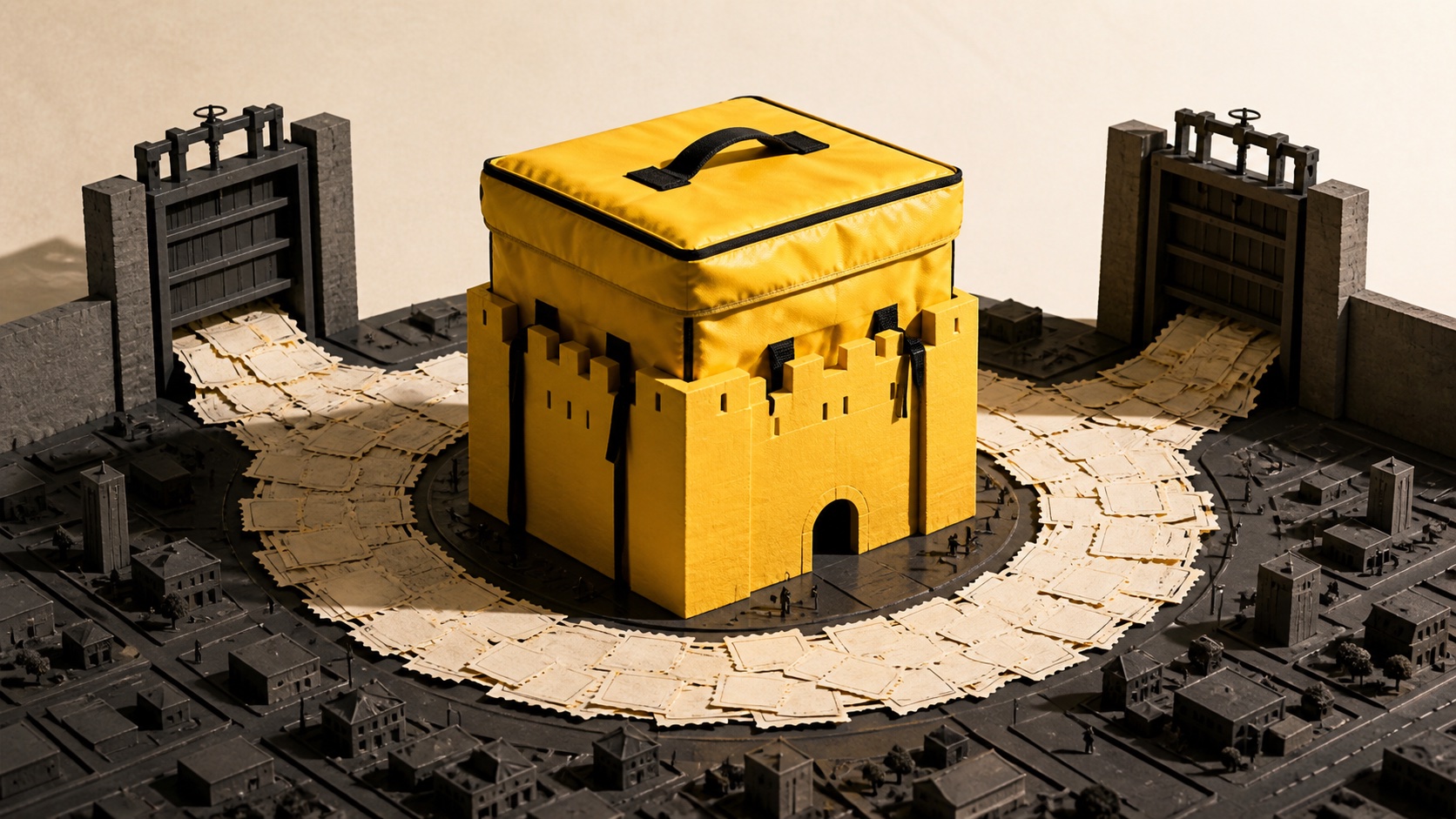
The centerpiece of the bull case is Anduril’s 10-year Army contract vehicle with a ceiling of up to $20 billion. But an IDIQ—indefinite delivery, indefinite quantity—is first a channel through which the government may issue task orders. It can be used heavily, lightly or not to its full ceiling. It is not the same as funded backlog, much less current revenue.
Defense valuation has three layers: the ceiling authorizes what could be spent; task orders specify what the customer actually buys; revenue recognition records what has been delivered. Putting layer one directly into a valuation is like treating a large credit-card limit as cash in the bank.
Anduril may still be changing procurement. Its Lattice platform can integrate sensors and autonomous systems faster than traditional programs. But investors should track task-order conversion, delivery gross margin, receivable days, factory capex and the true software share of each award. Until then, “software-defined defense” remains a story only partly translated into cash.
A Bubble Can Be Built on Real Demand
PitchBook counted a record $19.8 billion across 262 defense-tech deals in Q1 2026. Using a narrower classification, Crunchbase counted $13.6 billion by mid-May, already running far ahead of 2025’s $8.8 billion record. Definitions differ; the direction does not.
Budgets are moving too. The Pentagon’s FY2026 request included $13.4 billion for autonomy: $9.4 billion for unmanned and remotely operated aircraft, $1.7 billion for surface autonomy, $734 million underwater and $1.2 billion for enabling software. Counter-drone requests added roughly $3.1 billion. This is demand in budget documents, not a pitch-deck TAM.
Yet real demand never guarantees a rational price. Railroads changed the world and produced bubbles. The internet created enormous value and still punished buyers who paid 2000 prices. Autonomous systems can reshape defense while investors in many defense startups earn mediocre returns. A correct industry thesis and a correct entry price are separate achievements.

Four Master Investors Stress-Test the Deal
Benjamin Graham would begin with margin of safety. Private marks move less often, not because they are safer, but because they are observed less often. A jump from $61 billion to $100 billion in two months demands a reverse DCF: what decade of revenue, margins and dilution must occur for an ordinary equity return?
Buffett would separate moat from customer dependence. Security clearances, mission data, integrated hardware-software and manufacturing scale can become formidable barriers. A concentrated government customer, political budgeting and capital intensity can also erode economics. The moat becomes real when repeat wins produce growing free cash flow with modest incremental capital.
Howard Marks would focus on cycle and price; Munger would invert. What breaks the model? Slow task orders, an accident, export restrictions, a budget change, low factory yields or hardware price competition. None must disprove defense tech. Any one may simply make 45 times revenue too expensive.
Watch Five Conversion Rates, Not Drone Videos
Track ceiling to task orders; task orders to recognized revenue; revenue to gross profit; profit to free cash flow; and R&D to repeatable products. Only when all five gates open does defense tech become a compounding business rather than a politically favored growth narrative.
The Anduril valuation assumes it can combine Palantir-like software economics with the budget scale of a defense prime while avoiding the weaknesses of both. Public markets have tested Palantir’s margins and renewals for years; legacy primes have scale and cash returns but slower growth and bureaucratic costs. Capturing only the attractive half of each model is an exacting execution burden.
Josh Wolfe’s early fight to back Anduril may prove one of the era’s great contrarian investments. But once the contrarian view becomes consensus, the next buyer is not making the same trade. The product can win, defense budgets can rise, early investors can make fortunes—and a buyer at $100 billion can still earn an ordinary return. All four can be true.
Recent posts












































Frequently asked questions
What is Anduril’s valuation?
Anduril raised at $61 billion in May 2026. Reuters reported on July 24 that it was discussing a possible new valuation near $100 billion, though no decision had been finalized.
Is Anduril’s $20 billion Army contract guaranteed revenue?
No. It is the ceiling of an IDIQ procurement vehicle. Actual revenue depends on funded task orders, delivery and accounting recognition, and the full ceiling may never be used.
Is defense tech a bubble?
Demand and budgets are real, but that does not make every price rational. Investors should test task-order conversion, margins, free cash flow, customer concentration and how much success is already priced in.
Do not value defense tech from the headline. Use Valuefocus to put contract ceilings, real orders, margins and capital spending into one valuation model.
Download Valuefocus