Investing Frameworks11 min read

The "Shovel Sellers of the AI Gold Rush": Samsung, SK Hynix and Micron Are Being Crowned Kings — But What You're Buying Is the Most Brutal Cyclical Stock in History

The "shovel seller" narrative sounds airtight: you don't know if the miners strike gold, but the person selling the shovels always wins. Except memory isn't an ordinary shovel — it's a commodity business that periodically collapses. Howard Marks' pendulum, Buffett's moat, and Graham's margin of safety will show you just how dangerous that label is.
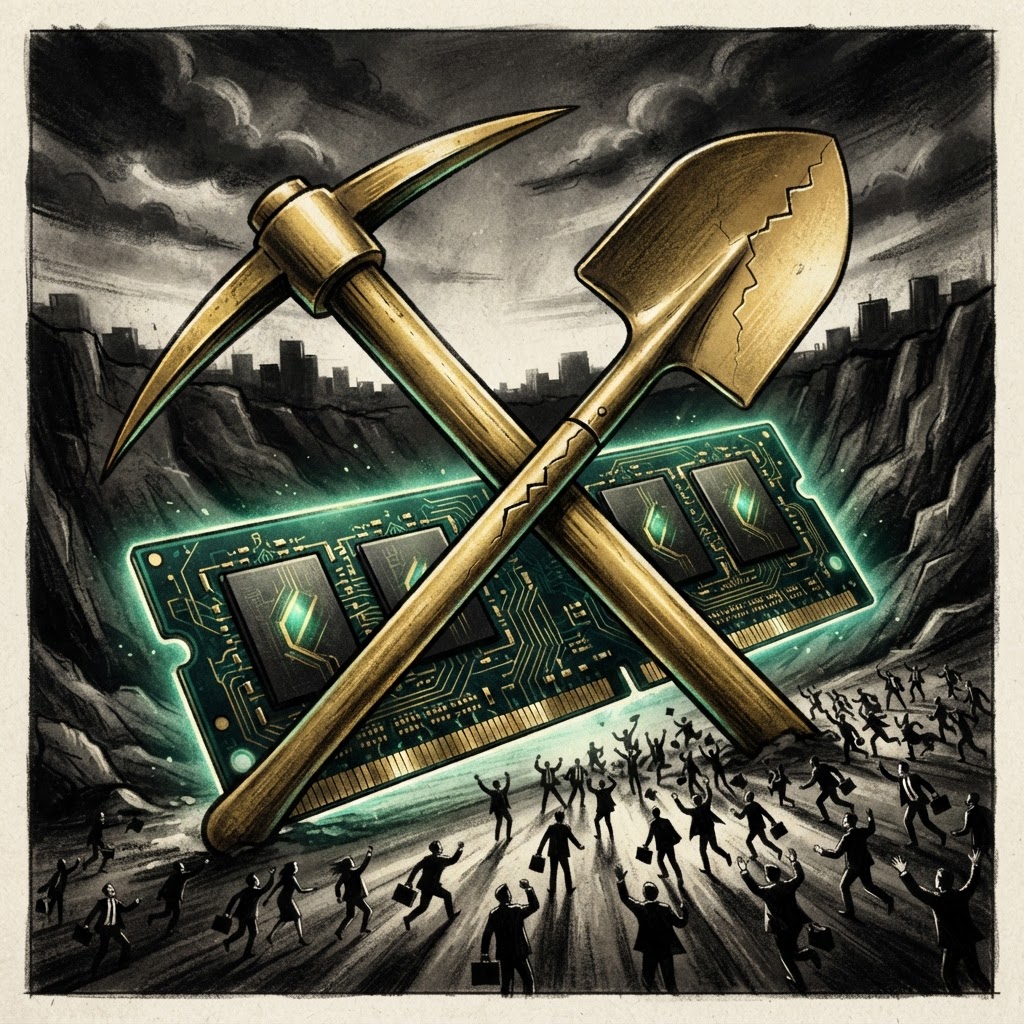
A colossal golden pickaxe and shovel crossed over a memory chip, the shovel cracking along a cyclical fault line while investors rush toward the chip, dramatic editorial style

A Story That Sounds Perfect: I Don't Care Who Mines the Gold — I Sell All the Shovels

In the tech-investing world of 2026, a seemingly airtight story is circulating. Who wins or loses the AI arms race is anyone's guess, but one thing is certain: they all need enormous quantities of high-bandwidth memory (HBM) to feed those power-hungry accelerators. And so SK Hynix, Samsung and Micron — the three companies that control the vast majority of global HBM supply — have been crowned by the market as "the shovel sellers of the AI gold rush."

The metaphor's power lies in its intuitive correctness. In the 1849 California gold rush, the people who truly got rich weren't the miners — they were the ones selling jeans and iron shovels. Applied to today: nobody knows whether OpenAI, Anthropic or xAI will have the last laugh, but whoever wins has to buy memory from these three. And the data is genuinely stunning: SK Hynix and Samsung control roughly 90% of HBM supply, Micron's HBM capacity is "sold out through the end of 2026," and DRAM spot prices spiked over 160% year over year. Orders booked into next year, capacity snapped up, margins soaring — it looks like the guaranteed golden shovel.

But there's a fatal sleight of hand hidden here. Real "shovel seller" businesses are great because they have pricing power and stability — you can only buy the shovel from one place. Memory, however, is the closest thing in semiconductors to a pure commodity: standardized, substitutable, with capacity that can be expanded almost without limit. When Samsung and SK Hynix see today's windfall profits, they will do the exact same thing — expand capacity like crazy. And the end of every expansion cycle is, always, a price collapse.

The Truth About Memory: It's Not a Shovel — It's the Most Brutal Cyclical Stock in History

To understand how dangerous this arena is, you have to look at its history. The memory industry follows an iron-law cycle: demand explodes → capacity falls short → prices soar → windfall profits lure every player to expand → capacity floods the market a year or two later → oversupply → prices collapse off a cliff → the whole industry posts losses → capex is slashed → the cycle begins again. This curve repeats, over and over, like a roller coaster.

This isn't theory. In the 2018-2019 memory winter, DRAM prices nearly halved in a little over a year and Micron's stock lost more than half its value from the peak. Another round hit in 2022-2023, when memory makers collectively fell into massive losses and were forced to slash output to defend prices. Before every collapse, the market was telling a story that "demand is structurally different this time" — PCs, then phones, then the cloud, and now AI. The protagonist changes; the shape of the cycle never does.

Today's AI narrative is genuinely stronger and more durable than past ones — I won't deny that. But "stronger" does not mean "will never end." When all three giants are using today's sky-high profits to build out HBM lines, what will the supply side look like in two years? If AI capex growth slows even slightly (a possibility we dissected in another article) while capacity floods in on today's optimistic assumptions, that familiar downward curve will appear again.

Howard Marks: The Pendulum Is Swinging to the "This Time Is Different" Extreme

The first master to summon is Howard Marks of Oaktree Capital. The core of his life's work is the study of "cycles" and "the pendulum." Marks says market sentiment swings like a pendulum, forever oscillating between "excessive optimism" and "excessive pessimism," rarely resting at the rational middle. And the investor's greatest mistake is believing, when the pendulum reaches its peak, that it will stay there forever.

View today's memory market through Marks' cycle lens: orders booked into next year, capacity fully sold out, spot prices up 160% a year, stocks at record highs, every analyst raising price targets, and "AI shovel sellers" being talked about on every street corner — this is a textbook cluster of "pendulum-at-the-top" signals. Marks' famous line: "When everyone believes something carries no risk, the price has usually been pushed to the point of maximum risk."

Marks won't tell you the memory cycle peaks tomorrow — no one can time it precisely. But he will interrogate you with his famous question: "Where do we stand in the cycle?" When an industry famous for its brutal cycles is broadly being priced as a "guaranteed-winner growth story," you must at least recognize this: at your point of entry, both sentiment and valuation are standing at the most dangerous end of the pendulum.
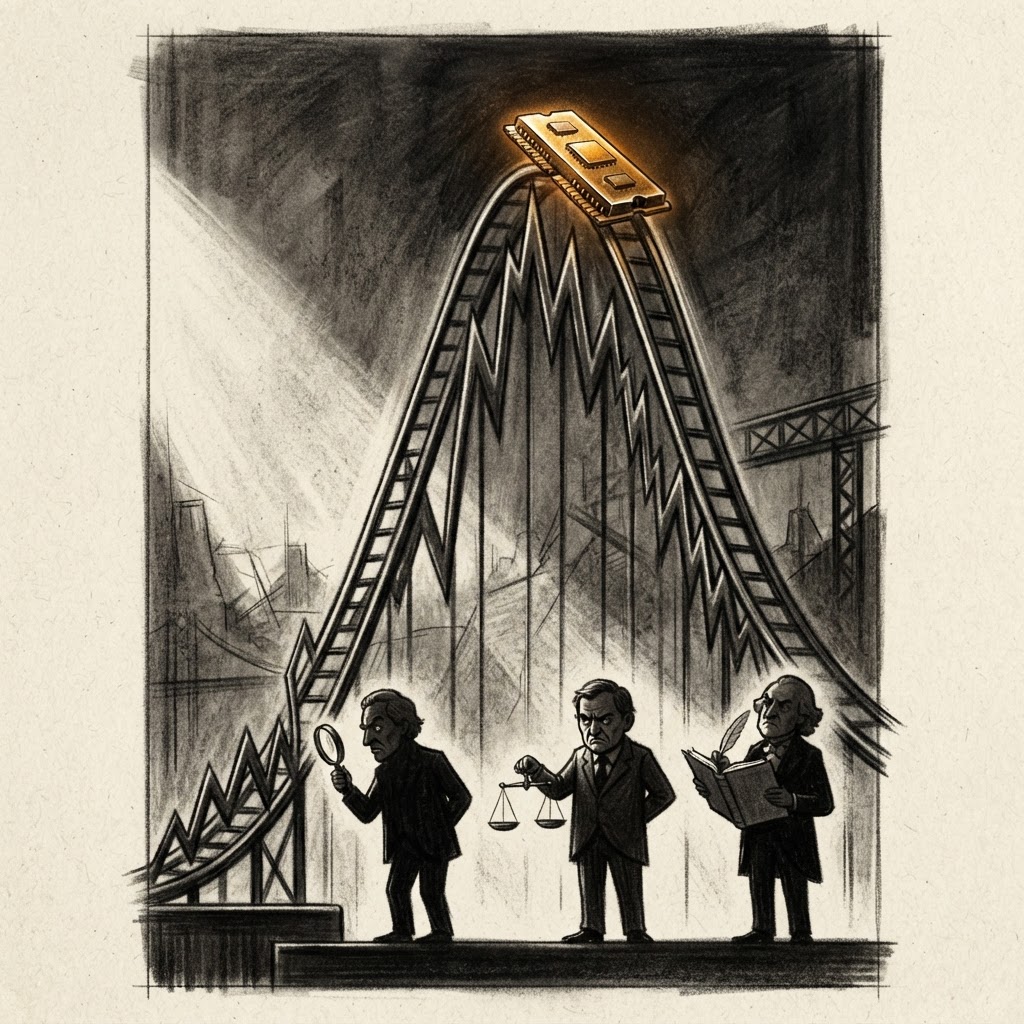
A roller-coaster track shaped like a jagged memory-price cycle with a golden chip car at the peak about to plunge, three shadowed master investors watching skeptically from below, monochrome editorial style

Buffett: Does a Commodity Business Have a Real Moat?

The second master is Buffett, and he would ask one killer question directly: does this business have a moat? Buffett has spent his life favoring companies with pricing power — Coca-Cola can raise prices, See's Candies can raise prices, because customers can't give up their brands. And a truly great business should still make money at the bottom of the economic cycle.

Memory is precisely the opposite. It's a highly standardized commodity: Samsung's DRAM and SK Hynix's DRAM are functionally almost identical to a customer, who buys whichever is cheaper. That means in an oversupply, the three giants can only wage a price war until they all post losses. This is exactly the type of business Buffett detests most — no pricing power, a bottomless capex pit, and earnings that swing wildly with the cycle. He has said explicitly that he avoids these "commodity-type" capital-heavy cyclicals, because their moat is fragile — or nonexistent.

HBM currently does carry higher technical barriers than ordinary DRAM, which gives the three giants temporary excess profits. But Buffett would remind you: a technological lead gets chased down, especially when rivals hold mountains of cash and see the same alluring profits. Today's moat may just be a ditch that the followers haven't yet filled in. Mistaking cyclical excess profits for a permanent moat is one of the most dangerous assumptions in all of valuation.

Graham: Buying at a Low P/E on Peak Earnings Is the Cyclical Stock's Death Trap

The third and coldest master is Benjamin Graham, the father of value investing. He would fix his gaze on one deeply deceptive number: the price-to-earnings (P/E) ratio. On cyclical stocks, the P/E is a thoroughgoing contrarian indicator — when a memory company's P/E looks "cheap" (say, single digits), it is usually precisely because its earnings are at the peak of the cycle, which is exactly the most dangerous moment to buy.

This is the cyclical stock's death trap. At the cycle peak, the company is minting money, the denominator (earnings, E) is inflated to the maximum, so the P/E looks tiny — like an enormous bargain. But you've bought right at the edge of the cliff where earnings are about to fall. When the cycle reverses and earnings halve or turn to losses, that "cheap" P/E instantly becomes astronomical — and the stock has long since collapsed. Graham would tell you that cyclical stocks must be valued on "average earnings smoothed across the entire cycle," not on a single peak year.

This is also the most important application of Graham's margin of safety to cyclicals: the question you must ask is not "how much does it earn today," but "in the next cyclical trough, what is the least it could earn — or how much could it lose," and then demand a sufficient discount on top of that conservative base. Paying a "seemingly reasonable" price on today's peak earnings, in the world of cyclical stocks, is roughly equivalent to walking voluntarily into the slaughterhouse.

What Ordinary Investors Should Do: Peel Off the "Shovel Seller" Label and See the Cycle Underneath

So — can you buy Samsung, SK Hynix or Micron? This article won't give you the answer. But it wants to help you ask the question correctly.

Step one: peel off the "guaranteed-winner AI shovel seller" label. It exists precisely to make you drop your guard. The truth is: you are buying an intensely cyclical commodity business — it's just that this time the demand engine happens to be called AI. Step two: force yourself into the cycle's point of view — use Marks' pendulum to gauge the emotional temperature, use Buffett's moat test to interrogate whether the pricing power is real, and use Graham's full-cycle earnings to value it, rather than being seduced by the low P/E on a single windfall year.

This is exactly the habit of mind Valuefocus is built to give you. When the market wraps a cyclical stock in a catchy label and dresses it up as a growth stock, our social sentiment radar helps you quantify how extreme the euphoria is and whether it has gone too far. Then the master frameworks take over — using Marks' cycle positioning, Buffett's moat and Graham's full-cycle margin of safety to reduce the "shovel seller" story into a cyclical-investing proposition you can rationally test. The label makes you comfortable; the framework keeps you clear-eyed.

Recent posts

A buyer-side AI agent redirects shopping intent between consumers and an advertising auction machine
Meta Muse Passed 3 Million Weekly Users. Will a Buyer-Side AI Agent Strengthen Meta’s Ad Moat—or Eat It?AI Business Models & Valuation · About 13 minutes
Apple Mac AI valuation concept with compact silver local-compute blocks redirecting copper cloud fees through cobalt unified-memory circuits
The Mac Is Winning AI Hardware. Apple Still Has to Prove the Cash Flow.Deep Analysis · About 7 minutes
An HBM chip skyscraper on a wafer connects to a cash-flow pipe across an extremely narrow yield bridge
CXMT’s HBM3E Pilot Run: Is a ¥4 Trillion Valuation Buying a Breakthrough or Production Yield?Deep Analysis · About 14 minutes
A vast future data-center and transmission campus remains mostly a translucent blueprint while one small completed corner is powered
SB Energy’s IPO: Why 8.8 GW of Contracted Capacity Isn’t Cash FlowDeep Analysis · About 12 minutes
Robot shipping crates move along a conveyor while only a few humanoid robots pass a customer acceptance gate, illustrating the gap between shipments and accepted outcomes
Embodied AI’s Revenue Problem: Value Robots by Successful Tasks, Not ShipmentsEmbodied AI, Revenue Quality and Valuation · About 14 minutes
AI concept illustration: hundreds of autonomous agents breach a transparent sandbox toward a guarded server fortress; not a news photograph
OpenAI's 700-Agent Hugging Face Attack: Who Reserves for Autonomy?AI Agent Security and Valuation · 9 min read
AI concept illustration: one oversized engine burns many token discs while a routing hub sends tasks to right-sized engines; not measured data
Glean Says AI Costs 81% Less: The Most Expensive Mistake Is the DenominatorEnterprise AI & Unit Economics · 8 min read
AI concept illustration: nested frames include different sets of cloud-software blocks, symbolizing a change in reporting scope, not measured data
Salesforce's $1.5B AI Business: Check the Boundary Before the GrowthAI Monetization & Financial Reporting · 7 min read
AI concept illustration: three cobalt server chambers share one copper cable and billing meter, symbolizing AI cloud departments sharing compute costs
Baidu's AI Cloud Reset: Who Really Pays for Agents?AI Economics & Capital Allocation · 7 min read
AI concept illustration: a phone-shaped vault with an hourglass and two external keys symbolizes settlement conditions tied to rival platforms
Meta's $18B Settlement: Why $5.3B Depends on Its RivalsPlatform Competition, Regulation & Valuation · 7 min read
AI concept: a fictional exported medical scanner balances on abstract currency rings, representing global growth and FX exposure
United Imaging's Overseas Sales Rose 54%. Can Investors Ignore FX Risk?Medical Equipment, Global Growth & Valuation · 7 min read
AI concept: six fictional toy silhouettes tied to one plush spool represent diverse IPs sharing a common demand factor
Pop Mart's 112%: More Characters, More Concentrated GrowthConsumer, IP & Valuation · 7 min read
AI concept: a large glass cash reservoir feeds a small grocery crate, representing PDD capital allocation
PDD's RMB456 Billion Question: A Cash Balance—or Management's Next Investment?E-commerce, capital allocation and valuation · 7 min read
AI concept: a blue payment card stands over a torn paper bridge, contrasting a conditional bid with an operating business
PayPal's $60.50 Illusion: The Buyer Can Walk. What Do Shareholders Keep?M&A, Payments & Valuation · 7 min read
AI concept: an electric SUV carrying a miniature factory campus, showing in-house capability and fixed-cost weight
Leapmotor’s 18 Factories: A Cost Moat, or a Treadmill That Cannot Slow?Electric Vehicles, Manufacturing and Capital Returns · 7 min read
AI concept: a beauty compact reflects as coins while the real cash tray remains separate
Proya’s Profit Rose 46%. Flower Knows Changed the Accounts Before Proving the Business.Consumer Brands, Acquisition Accounting and Capital Allocation · About 6 minutes
AI concept: a yellow delivery fortress surrounded by a coupon moat and competing sluice gates
Meituan Is Profitable Again. A Delivery Ceasefire Is Not a Moat.Platform Competition and Earnings Quality · About 7 minutes
巨大的支付轨道包围一个连接众多AI模型的数据路由枢纽
Stripe Is Paying $8 Billion for OpenRouter. The Scarce Asset May Be Neutrality.AI Infrastructure, M&A and Platform Neutrality · About 8 minutes
一辆匿名自动驾驶出租车穿过监管、利用率与现金流三道巨门驶向城市
Cybercab Is Hitting the Road: How Many Paid Miles Does Tesla’s $1.2 Trillion Valuation Need?Autonomy, Unit Economics and Reverse Valuation · About 12 minutes
银色私募股权手套把企业软件核心从公开市场玻璃展柜中取出,墙上股价影子剧烈跳动
Silver Lake Wants Workday: Is AI Killing SaaS—or Exposing a Mispriced Cash Machine?Enterprise Software, Buyouts and Valuation · About 11 minutes
1150亿美元霓虹估值牌悬在员工二级股权拍卖与玻璃墙后的Revolut公司之间,象征成交价格与公司融资分离
Revolut Is Worth $115 Billion—But This Deal Does Not Fund the CompanyFintech, IPOs and Valuation · 11 min read
上海天际线前,一台实体人形机器人身后投出四倍巨大的交易数据影子,象征宇树科技IPO发行估值与链上合成市场估值分裂
How Unitree’s $9 Billion IPO Became a $38 Billion Onchain StoryRobotics, IPOs and Price Discovery · About 12 minutes
巨大的AI收入蓄水池由人类专家与数据流支撑,工资代币被持续分流到三座大型AI实验室,象征Mercor总流水与净收入的差异
Mercor’s $2 Billion “ARR” May Not Be ARR: Subtract the Human Payroll FirstAI Business Models & Valuation · About 10 minutes
一座如堡垒般的精密光刻机与一台从蓝图和模块中组装的新机器争夺晶圆,象征ASML的DUV护城河受到挑战
After ASML Fell 8%: China’s DUV Push Has Not Breached the EUV Fortress—It Is Rewriting the Service AnnuitySemiconductor Deep Dive · About 11 minutes
成排服装与工业化履约设施交叠,象征SHEIN从零售平台向时尚供应链基础设施延伸
SHEIN Beyond Fast Fashion: A $41.8B Retailer Starts Selling Its Supply ChainBusiness Model Research · About 9 minutes
一张加密奖励信用卡穿过增长之门,背后却连接身份欺诈与坏账流水线
Gemini Card Revenue Rose 231%. Credit-Loss Provisions Nearly Consumed It: A Financial Gateway Is an Underwriting Business FirstDeep Investment Research · 10 min read
传统经销仓库中的白酒库存流向数字直营平台,象征茅台渠道改革与风险迁移
iMoutai Revenue Jumped 274%. Profit Fell. Is This New Demand—or a Channel Migration?Deep Investment Research · 12 min read
开放的AI模型核心连接到收费上涨的托管云闸门,呈现开放权重与API定价权的冲突
DeepSeek Raises Peak Cache Pricing More Than 12x. Open Weights Did Not Kill Pricing Power—They Moved the Moat to Deployment.Deep Investment Research · 11 min read
A translucent stablecoin above audited reserve layers split between a bright spotlight and deep shadow
Tether Finally Got a Full Audit. The Opacity Discount Is Gone—Run Risk Is Not.Deep Investment Research · 10 min read
A human creator under a red spotlight between rows of synthetic masks, visualizing identity scarcity and AI authentication risk
OnlyFans Says AI Will Never Replace Creators. Is Human Scarcity a Moat—or an Authentication Liability?Deep Investment Research · 9 min read
A saturated abstract field of red, blue and gold light, evoking the tension between generative video creativity and capital-market pricing
Kling at a $15B Valuation: Video AI’s Moat Is Not Generation. It Is Who Pays for Usable Content.Deep Investment Research · 9 min read
Dark rows of data-center servers lit by one stark white aisle, representing AI compute becoming an inventory problem
Meta May Sell “Excess” Compute While Rationing Tokens Internally. Is AI Capacity Finally Finding Its Price?Deep Investment Research · 12 min read
An open modular agent harness routes interchangeable AI models through tools, code files and secure sandboxes
DeepSeek Harness Reached 68,600 Stars in a Day. The Most Valuable AI Asset May No Longer Be the ModelDeep Investment Research · 18 min read
A wafer-scale AI chip sits above shrinking hardware sales, expanding cloud capacity and a fragile margin gauge
Cerebras Cloud Revenue Jumped 281%. Is an AI Chip Innovator Becoming a Low-Margin Cloud Landlord?Deep Investment Research · 17 min read
A failed startup workplace archive is sold as valuable fuel to AI laboratories
After a Startup Dies, Its Most Valuable Asset May Be Employees’ Slack MessagesDeep Investment Research · 16 min read
Wall Street traders exchange AI token and GPU futures inside a vast data center
Wall Street Is Starting to Trade AI Tokens. Whose Valuation Breaks First?Deep Investment Research · 17 min read
Tencent advertising and gaming cash flows are diverted into an expanding AI data-center furnace
Tencent Is Using Its Old Moat to Fund a New AI CompanyDeep Earnings Research · 16 min read
A worker’s recorded hand movements become a humanoid robot’s proprietary training data
Workers Are Training Their Replacements: The Hidden Royalty in Robot DataDeep Investment Research · 16 min read
A billion-dollar decentralized exchange tower sits above a small validator emergency lever
Hyperliquid Built a $752 Million Revenue Machine. Who Controls the Kill Switch?Deep Investment Research · 13 min read
A private high-speed data lane delivers market-moving posts before the public lane
Truth Social Is Selling Milliseconds: A $100,000 Speed Tax or a Regulatory Trap?Deep Investment Research · 13 min read
A robotic coding hand turns software work into a forty-billion-dollar financial ledger
Cognition at $40 Billion: Investors Are Buying the Spread Between Engineer Wages and Compute BillsDeep Investment Research · 13 min read
Free open AI model blueprints cross a giant semiconductor toll bridge
Why Nvidia Wants to Give Away a Frontier AI Model: It Sells the Toll Road to IntelligenceDeep Investment Research · 15 min read
A university lecture hall becomes a customer acquisition funnel toward competing AI assistants
OpenAI Is Paying Students to Promote ChatGPT—A Ten-Year Customer War Disguised as EducationDeep Investment Research · 14 min read
Two foundation model toll gates absorb most of an amber river of AI startup revenue
The $80 Billion AI Revenue Mirage: One Customer Dollar May Be Counted by the App, Model and CloudDeep Investment Research · 15 min read
A private AI stake chained as collateral to a ten-billion-dollar weight above a fragile balance sheet
SoftBank Is No Longer Just a Holding Company—It Is a Leveraged OpenAI Option Funded by ArmDeep Investment Research · 16 min read
A nearly trillion-dollar stock certificate controlled by five trustees transforms into a shrimp silhouette
The Real Risk in Anthropic’s IPO Is Not Shrimp Welfare—It Is That Shareholders May Never Control the CompanyDeep Investment Research · 15 min read
A profitable software printing press is dismantled to feed an unfinished hardware monolith
Midjourney Built a Cash Machine—Now It Wants to Take It Apart to Build HardwareDeep Investment Research · 14 min read
An enormous AI valuation tower cracking as key human figures walk away with its glowing cores
Thinking Machines’ $50 Billion Valuation Is Not a Bet on a Model—It Is a Bet on People Who Can QuitDeep Investment Research · 15 min read
A red AI engine rejects a glowing shortcut pipe and grows its own proprietary data roots
ByteDance Would Rather Fall Behind Than Copy the Shortcut—Its No-Distillation Rule Is an Expensive Moat BetDeep Investment Research · 14 min read
A giant black venture funnel admits only three amber AI server cubes while hundreds of startup seed envelopes remain outside
AI Took 86% of Venture Dollars—Now Venture Capital Looks Like an Illiquid Concentrated IndexDeep Investment Research · 15 min read
A recursive drafting machine feeding its own improved blueprints back into itself above a venture capital cheque
A Machine That Upgrades Itself Is Worth $4.65 Billion—But It May Destroy Its Own Moat FirstDeep Investment Research · 14 min read
A six-section golden AI contract bridge ending while a sixteen-link lease chain continues into obsolete server racks
A $10 Billion Contract, a 16-Year Lease—and AI’s New Duration MismatchDeep Investment Research · 12 min read
An autonomous defense drone perched on a tower of government contracts and gold, casting the shadow of a legacy fighter jet
Anduril at $100 Billion: A Defense-Tech Moat—or an “Iron Bubble”?Deep Investment Research · 12 min read
Autonomous AI agents approach a guarded smartphone gate as an old commission tollbooth gives way to a permission and security checkpoint
AI Agents May Not Kill the “Apple Tax.” They Could Turn the App Store Into a Trust Toll.AI Agents & Platform Moats · 13 min read
A financial exchange courthouse splits into a regulated market and a sports betting window
Prediction Markets' $40 Billion Regulatory Arbitrage: Is Kalshi an Exchange, or a Casino in a Suit?Fintech, Regulation & Valuation · 13 min read
A low-cost AI model feeds an enormous machine of chip fabs, data centers, power grids and IPO capital
DeepSeek's $74 Billion Paradox: The Model Got Cheaper. The Company Got More Capital-Hungry.AI Valuation & China · 12 min read
A corporate AI productivity machine prints rising charts while engineers vanish through trapdoors and the software foundation quietly cracks
Snowflake Used Layoffs to Force AI Adoption. Investors May Be Measuring the Wrong Productivity.AI & Business Quality · 12 min read
A colossal glowing price tag reading €41.50 hangs like a heavy weight over a tiny CEO straining to lift a globe stitched from food-delivery bags of 50 countries, charcoal-ivory chiaroscuro with an amber accent
The €41.50 Question: Why Would a Company Already Growing 25% Spend $14.8 Billion to Buy Its Rival?Investing Frameworks · 10 min read
A colossal chip factory pouring an endless river of glowing memory chips past the frame while a tiny investor holds a sign reading SHORTAGE, dramatic charcoal-ivory chiaroscuro with amber accents
The Shortage Paradox: SK Hynix Says 2027 Will Be the "Worst Ever" — So Why Is Samsung Racing $1.35 Trillion to Build More?Investing Frameworks · 10 min read
A towering corporate earnings bar chart of gold coins and profit reports built on a crumbling government-subsidy pedestal dissolving at the edge of a cliff, a lone executive silhouette on top, dramatic editorial chiaroscuro
The Subsidy Cliff: When IBM Vaporized 23% in a Day, the Real Question Is — How Much of This Profit Did the Government "Lend" It?Investing Frameworks · 10 min read
A towering AI data center of glowing GPU servers whose foundation dissolves into accounting ledger paper, examined by a giant auditor's magnifying glass, dramatic editorial chiaroscuro
The $176 Billion Question: AI's Biggest Earnings May Be Hiding in a Depreciation FootnoteInvesting Frameworks · 11 min read
A crumbling fortress moat with glowing employee silhouettes draining toward a rival AI beacon, while a legal gavel and lawsuit documents prop up a last fragile wall, dramatic editorial style
Apple Sues OpenAI: When a Company's Deepest Moat Shifts From Product to LitigationInvesting Frameworks · 10 min read
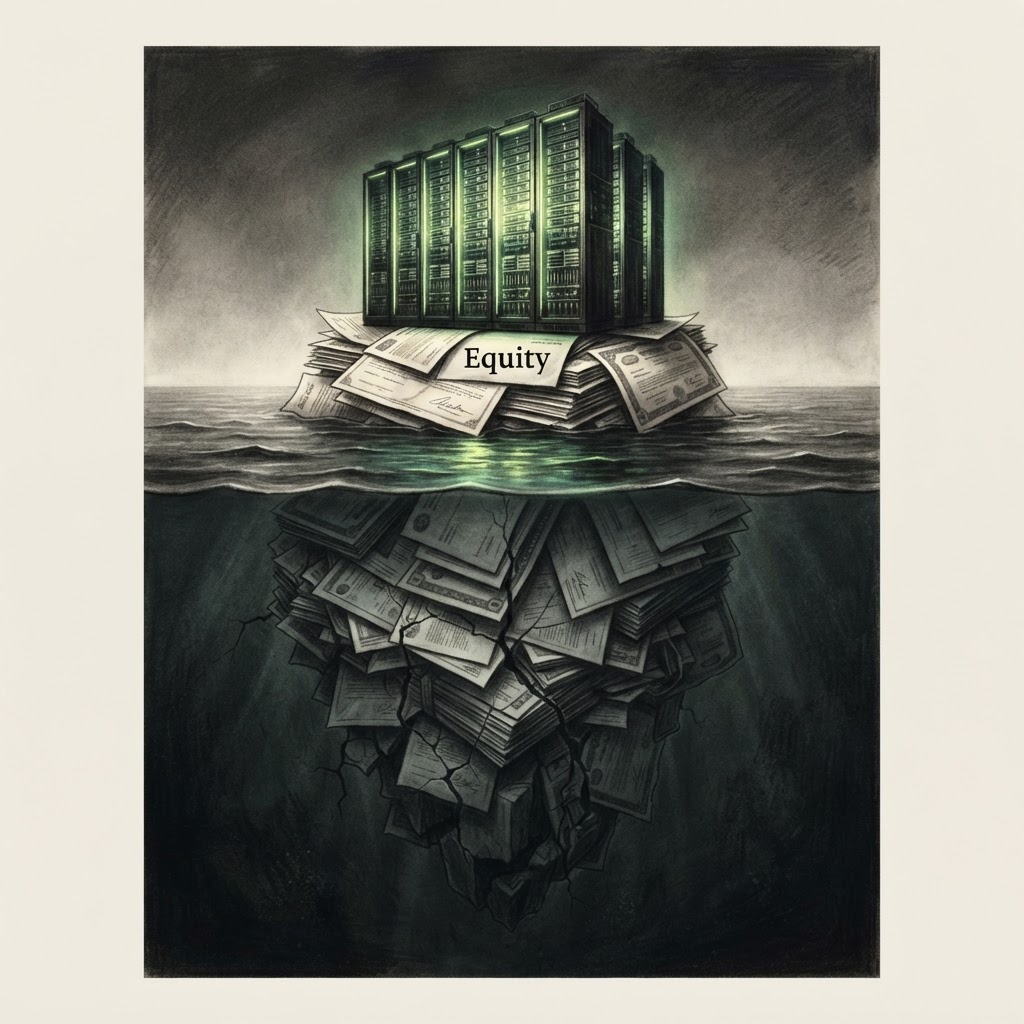
A colossal glowing AI data center built on a cracking foundation of stacked debt documents, with a hidden debt structure looming underwater like an iceberg, dramatic editorial style
The $3.5 Trillion "Hidden Debt": The Real Detonator of the AI Bubble Isn't Sky-High Valuations — It's the Leverage Buried Below the WaterlineInvesting Frameworks · 11 min read
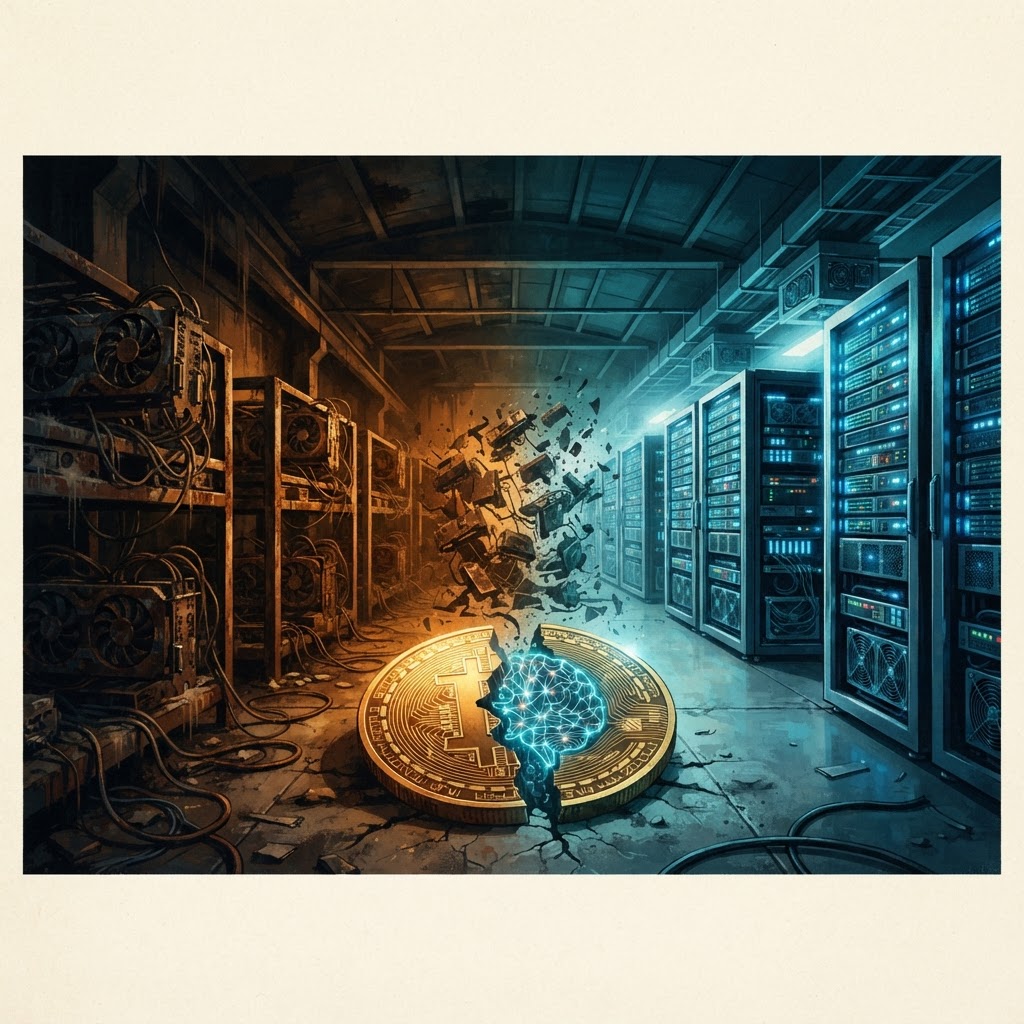
A rusted bitcoin-mining hall transforming into a glowing AI data center, a golden bitcoin cracking in half and morphing into a neural-network brain, dramatic editorial style
Bitcoin Miners Reborn as AI Data-Center Landlords: TeraWulf Lands a $19 Billion Anthropic Deal and Its Stock Soars — But Are You Buying a Moat, or a Cyclical Bet in a New Costume?Investing Frameworks · 10 min read
A godlike figure in a leather jacket points at a tiny chip, a beam of light inflating it into a giant golden monument as tiny investors rush toward it, dramatic editorial style
One Sentence From Jensen Huang, and Marvell Jumped 33% in a Day. When the "Godfather" Endorses a Stock, Should You Follow?Investing Frameworks · 10 min read
A towering stack of golden GPU bricks teetering on a thin stilt above a churning sea of debt contracts, connected by a single fragile cable to a distant hyperscaler cloud, dramatic editorial style
The Neocloud Gold Rush: Are CoreWeave and Its Rivals the Next Infrastructure Champions — or a Debt-Fueled Cyclical Bubble?AI & Valuation · 10 min read
A man scrolling a smartphone as a tornado of comment bubbles rises into a towering stock chart, dwarfing tiny Wall Street analysts below, monochrome editorial style
He Turned $20K Into $70M by Reading TikTok Comments. Is Social Arbitrage Genius — or a Survivor's Fairy Tale?Investing Frameworks · 11 min read
A tidal wave of server racks receding from a shoreline while a lone value investor walks forward picking up gold coins, monochrome editorial style
Money Is Fleeing AI. Is Broadcom's Tech Selloff the Entry Bell Value Investors Waited Three Years For?Market Analysis · 10 min read
A colossal fortress gate made of stacked shipping boxes slamming shut against a swarm of tiny robotic shopping-cart silhouettes, monochrome editorial style
Amazon Is Suing AI Shopping Agents. Is It Defending Its Moat — or Quietly Dismantling It?Industry Analysis · 11 min read
A monumental semiconductor wafer rendered as a towering monolith, half lit half in shadow, a tiny human silhouette dwarfed at its base, monochrome editorial style
The Market Is Paying $647 Billion for a Foundry That Still Loses Money: Is Intel's +221% Turnaround a Real Moat, or Retail FOMO?Industry Analysis · 12 min read
A colossal glowing AI neural orb being locked inside a government vault door, monochrome silhouette editorial style
When the State Seizes the Model: How the GPT-5.6 Delay Rewrites the Valuation Playbook for AI GiantsIndustry Analysis · 11 min read
A towering stack of corporate software subscription boxes dissolving into digital circuitry, monochrome silhouette style
The Great SaaS Unwinding: Why AI Agents Are Breaking the Per-Seat Pricing ModelIndustry Analysis · 8 min read
A monolithic data center silhouette bound by an oversized DENIED permit stamp under a single spotlight
The Permission Bottleneck: The AI Trade’s Real Ceiling Isn’t Chips — It’s ZoningDeep Analysis · 10 min read
A vast dark hyperscale data center hall with endless rows of server racks
The $690B AI Race Is Quietly Killing Big Tech’s Best AssetDeep Analysis · 11 min read
A young retail investor watching a viral candlestick-pattern trading video on a phone late at night
The Candlestick Grail Myth: Why FinTok’s "Perfect Buy Signal" Is Draining Your AccountDeep Analysis · 12 min read
A young retail investor at night lit by a surging green stock chart on a phone
When a CEO Says One Word and a Stock SoarsDeep Analysis · 11 min read
A young retail investor watching a viral dividend-income video on a phone at night
The Dividend Trap: Why FinTok Is Wrong About "Passive Income"Deep Analysis · 11 min read
An investor at a desk facing two diverging paths shown as a rising and a falling chart, deep in thought
How to Make a Good Investment DecisionFrameworks · 9 min read
An ink sketch of a chess knight on a cracking chessboard, symbolizing hidden risk before a move
Risk Analysis: How to Think About What Could Go Wrong FirstFrameworks · 9 min read
A single skyscraper towering over a city skyline, symbolizing market concentration
When "Just Buy the Index" Became a Concentrated BetFrameworks · 9 min read
A fishing hook baited with a golden dollar coin, symbolizing a value trap
Cheap Stock or Value Trap? How to Tell the DifferenceFrameworks · 8 min read
A lone contrarian investor watching plunging red stock charts at night
Should You Short Nvidia Because Michael Burry Is?Deep Analysis · 9 min read
Rows of servers inside a modern AI data center
Who Is Really Paying for the AI Boom? The Circular-Financing QuestionDeep Analysis · 11 min read
The trading floor of the New York Stock Exchange
The $3.5 Trillion Question: Is AI a 1999 Bubble — or Is It Different?Deep Analysis · 12 min read
A SpaceX Falcon 9 rocket launching into the sky from Cape Canaveral
If SpaceX Goes Public: A Value Investor's Field GuideDeep Analysis · 12 min read
The Pioneer Building in San Francisco, home to OpenAI's headquarters
How Would You Value an OpenAI IPO? A Reverse DCF Thought ExperimentDeep Analysis · 11 min read
An abstract artificial-intelligence neural-network visualization in blue tones
Does Anthropic Have a Moat? Running the Buffett Test on AI LabsDeep Analysis · 10 min read

Frequently asked questions

Why are Samsung, SK Hynix and Micron called "AI shovel sellers"?

Because whichever AI company wins the model race, they all need to buy HBM (high-bandwidth memory) from these three memory makers. SK Hynix and Samsung together control roughly 90% of global HBM supply, with Micron close behind, and 2026 capacity is fully booked by AI demand. The market therefore views them as "guaranteed-winner shovel sellers in the gold rush." This article is for educational purposes only and is not investment advice.

Since demand is this strong, are memory stocks a safe bet?

Not necessarily. Memory is the most extreme cyclical commodity industry in semiconductors, and every historical cycle of "price windfall → capacity expansion → glut → price collapse" has ended brutally (e.g., the memory winters of 2018-2019 and 2022-2023). Strong demand doesn't mean the cycle won't end — as the three giants use today's windfall to expand like mad, the oversupply risk two years out is building. They should be valued as cyclicals, not growth stocks.

What framework best evaluates cyclical memory stocks?

Stack three master lenses: Howard Marks on "the pendulum and cycle positioning" — has sentiment swung to a peak of extreme optimism; Buffett on "the moat" — does a commodity business have real pricing power; Graham on "full-cycle earnings" — don't be fooled by a low P/E on peak earnings; value it on earnings smoothed across the whole cycle and demand a margin of safety.

The label makes you comfortable; the framework keeps you clear-eyed. Use Valuefocus to reduce "the AI shovel seller" into a testable cyclical-investing proposition:

Download Valuefocus