
AI Economics & Capital Allocation7 min read
Baidu's AI Cloud Reset: Who Really Pays for Agents?
Baidu is putting model services, agents and industry applications into different departments. A clearer organization chart does not necessarily mean clearer economics: who decides whether an agent using in-house compute is actually profitable?

One organization chart, two different businesses
On August 29, LatePost reported that Baidu AI Cloud was moving MaaS, Qianfan and related model services into infrastructure, separating general agents into an agent division, and moving data capabilities toward intelligent applications. This is a reported product-and-engineering reorganization, not the listing of three separate companies.
The interesting question is not who reports to whom. The same compute bill now crosses departmental boundaries. Infrastructure wants to sell more capacity; an agent wants to complete tasks cheaply. Both businesses growing does not establish that both independently earn attractive profits.
My thesis: the potential benefit is making internal subsidies easier to identify and govern, not creating more AI labels that can command separate valuations. The reorganization has not yet demonstrated that benefit.
Before extrapolating 283%, identify the business
Baidu's August 18 second-quarter results reported 283% year-over-year revenue growth for GPU Cloud, which sits within AI Cloud Infra. It is not the growth rate for the whole cloud business. Both revenue amounts below are in RMB billions:
| Q2 reporting category | Revenue (RMB bn) | Year over year | Quarter over quarter |
|---|---|---|---|
| AI Cloud Infra (RMB bn) | 7.3 | +50% | −17% |
| AI Applications (RMB bn) | 2.5 | +3% | +3% |
Reporting categories are not the new departments
AI Applications includes products such as Wenku and Baidu Drive. Its revenue cannot be assigned wholesale to the new agent division. The reporting quarter ended in June; the reorganization was implemented in August. The published categories do not provide separate profit, invested capital or internal charging policies for the three new divisions.
Infrastructure can grow year over year while declining sequentially. Slower application growth also does not establish an absence of agent demand. The mistake would be extrapolating the fastest growth rate and importing a software margin to complete a profit statement that was never disclosed.
In the same quarter, Baidu General Business revenue was RMB25.2 billion, down 4% year over year; online marketing revenue was RMB13.1 billion, down 19%. New revenue is growing alongside shrinking older revenue. The steepest curve is not a proxy for the whole company, and quarterly disclosures are not late-August run rates.

An illustrative ledger: moving profit does not create it
Consider a purely illustrative project. A customer pays RMB100. Infrastructure incurs RMB55 of actual resource costs, and application delivery costs RMB20. Before central R&D, taxes and other expenses, total project contribution is RMB25. These are not Baidu's actual costs or accounting policies.
Charge the application RMB40 internally, and infrastructure contributes negative RMB15 while the application contributes RMB40. Charge RMB60, and those contributions become RMB5 and RMB20. The combined result remains 100−55−20=25.
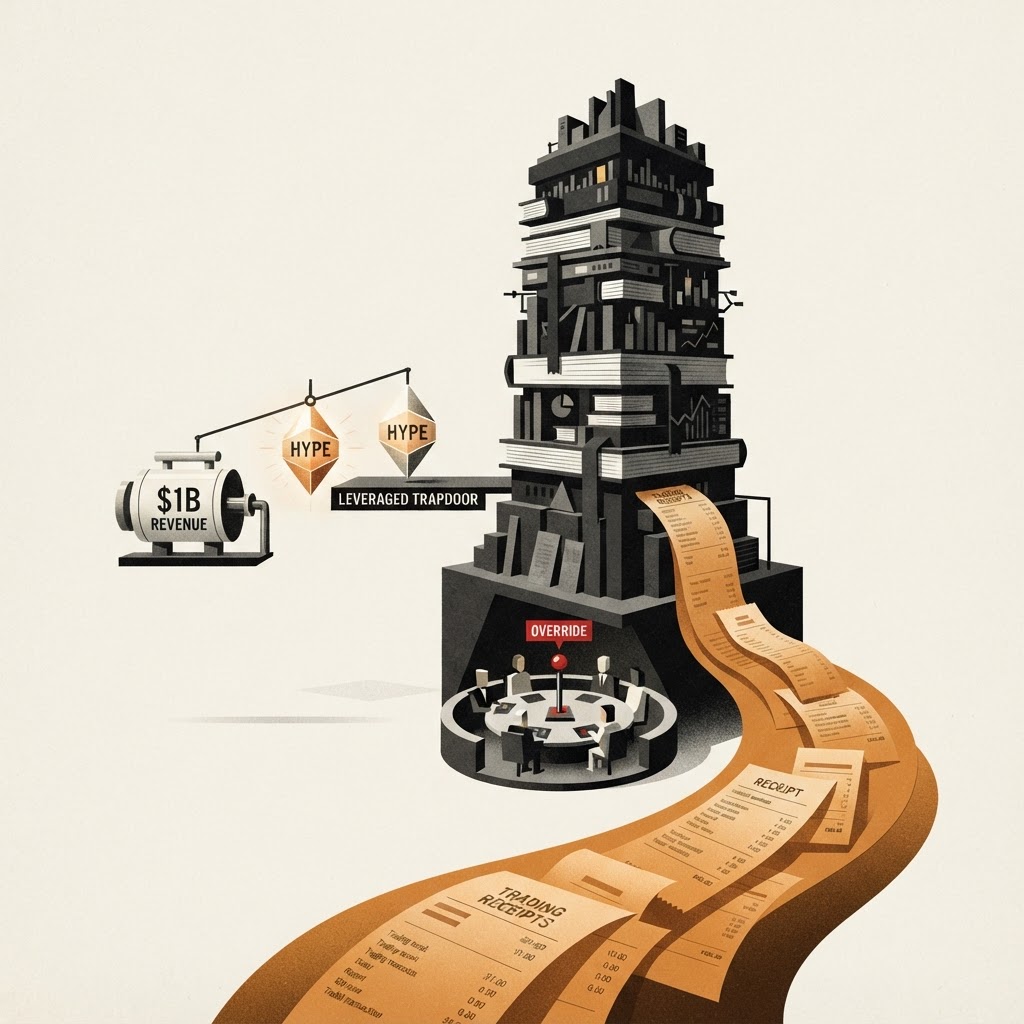
An analyst assigning a higher multiple to applications than infrastructure can manufacture modeled value just by moving profit toward applications. Shareholders receive no additional money. This is a boundary problem in sum-of-the-parts valuation, not an allegation about Baidu's accounting.
Internal services can legitimately carry charges. But consistent treatment of costs and internal transactions must precede valuation. More reporting detail does not make economic value freely additive.
Idle compute cannot be both free lunch and premium rental capacity
Using an idle machine may require relatively little incremental spending for one more task. Discounted compute for an early agent product is not inherently misguided: it may fund faster experimentation and customer feedback.
A long-term valuation must nevertheless identify who pays for replacement equipment, operations and capital employed. It cannot assume that an agent enjoys nearly free compute forever while the same capacity is fully rented externally at premium prices. That sells the same scarce resource twice.
Conversely, forcing every internal call to bear a retail price can kill worthwhile experiments. Relevant comparisons include obtainable outside quotes, incremental costs and alternative uses of capacity—not one supposedly correct internal price.
Investors need two answers: is the project worth continuing with currently idle capacity, and can it cover full economic costs after expansion? The first informs today's experiment; the second supports a durable valuation premium.
Buffett asks about capital; Damodaran asks about assumptions
Methodology applications, not current opinions about BaiduWhat capital does growth require, and what assumptions support profit?
- Warren Buffett: His 2007 shareholder letter compares the capital required to expand earnings across different businesses. Applied here, the question is what durable return additional compute earns—not merely how fast GPU revenue grows. Growth does not waive the cost of capital.
- Aswath Damodaran: His valuation introduction addresses estimation and firm-specific uncertainty. Internal costs, renewals and utilization should be explicit scenario assumptions, not hidden behind precise multiples.
What to ask at the next earnings release
First, do paying customers renew after promotions end? Second, what contribution remains per customer-accepted task after retries and human remediation? Third, how much external cash collection follows additional compute investment, rather than merely higher invocation counts?
The constructive scenario combines better task quality, renewals and lower full costs. Counterevidence would be usage driven chiefly by subsidies while revenue growth continually demands heavier capital investment. Current disclosures are insufficient to assign credible probabilities to those outcomes.
Use a reverse DCF to test the growth embedded in a price, and an investment risk checklist to record cost and renewal assumptions. For an emerging agent business model, an honest blank is more useful than an attractive invented margin.
Baidu's reset may improve decisions, or it may merely move budget boundaries. What deserves shareholders' money is not three convincing departmental stories, but a system that sustainably wins more external customer money with fewer resources.
Recent posts















































Frequently asked questions
Did all of Baidu AI Cloud grow 283%?
No. That is second-quarter 2026 year-over-year revenue growth for GPU Cloud, a subset of AI Cloud Infra. The infrastructure category as a whole grew 50%.
Is RMB2.5 billion of AI Applications revenue the new agent division's revenue?
No direct equivalence is supported. The quarterly category includes Wenku and Baidu Drive. The table does not establish the August divisions' scope, internal transactions or separate profits.
Would higher internal compute charges raise group profit?
Not by themselves if external revenue and actual resource costs remain unchanged. Charges redistribute departmental contribution; changes in incentives and real resource allocation could subsequently change group economics.
Is the RMB100 project based on Baidu operating data?
No. It is a simplified transfer-pricing illustration that excludes central R&D, taxes and other expenses. Its RMB25 contribution is not a Baidu margin estimate or a price target.
Use Valuefocus to organize Baidu's disclosures and reorganization reporting. Record revenue growth, compute costs and capital-return assumptions separately, then apply investing frameworks to counterevidence before judging the margin of safety.
Download Valuefocus