
Capital Allocation & ValuationAbout 6 minutes
Meta’s $97.5 Billion Financing Plan: What Non-Voting Shares Mean for Per-Share Value
Meta can raise equity without issuing new votes through its planned Class C stock. For ordinary shareholders, the harder question is whether the cash generated by AI investment can outgrow the share count.

Three financing instruments, three timelines
On November 8, The Information tallied over $300 billion in new shares and mandatory convertibles sold or priced by AI-related companies in 2026, with roughly another $100 billion in potential offerings. A day later, LatePost published an interview questioning how far investors could extrapolate hardware scarcity and margins. Meta’s financing offers a way to put both questions into one model: when does the cash arrive, and who gets the returns?
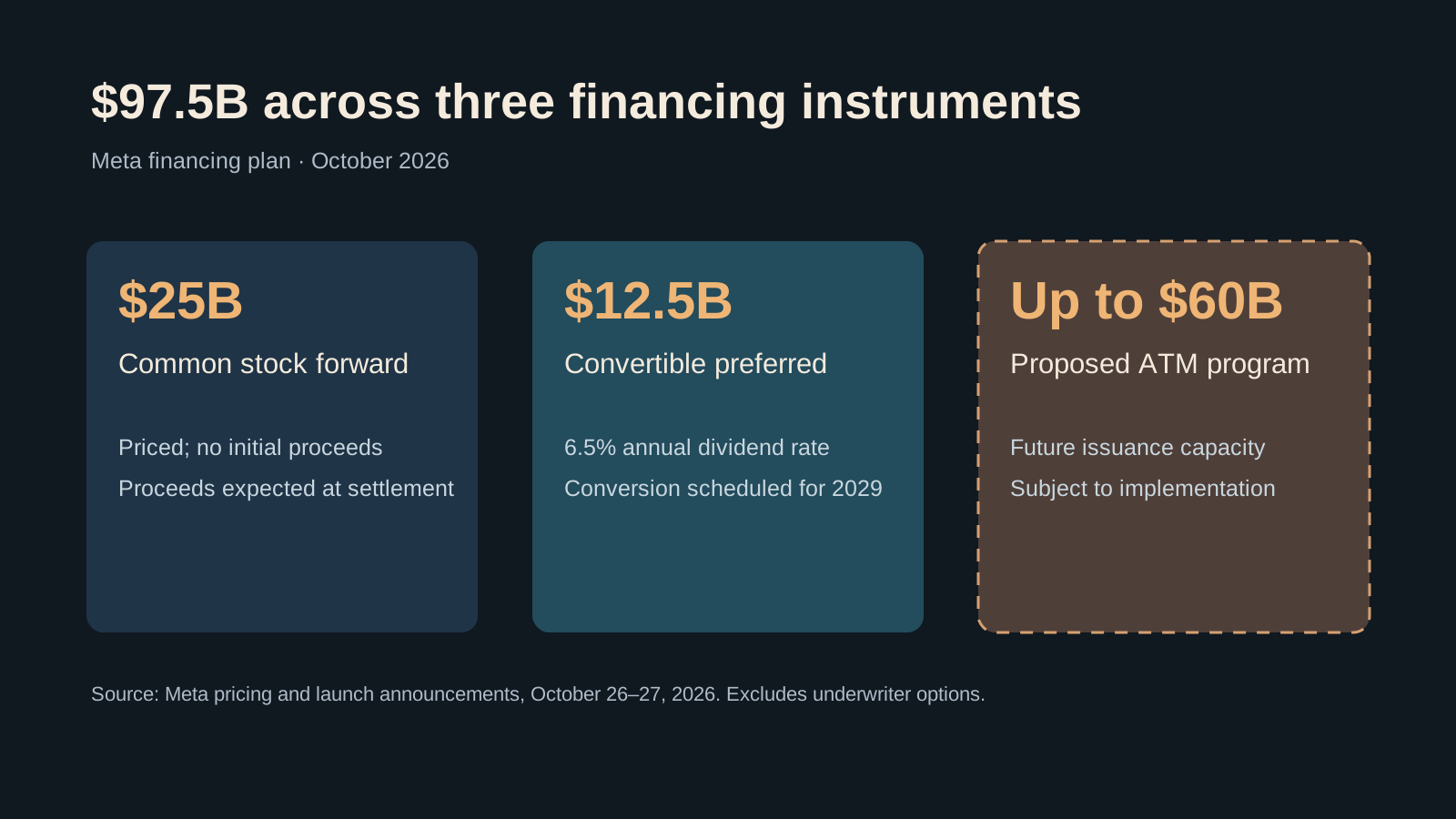
Meta priced $25 billion of Class A stock at $625 a share through forward sale agreements and $12.5 billion of mandatory convertible preferred stock carrying a 6.5% annual dividend rate. A proposed at-the-market program for up to $60 billion, which could begin in 2027, brings the announced total to $97.5 billion before underwriter options. Under the forward structure, Meta expects no initial proceeds from the borrowed shares sold by counterparties. It expects about $24.9 billion before expenses on settlement by November 19, 2027, subject to adjustments. Pricing announcement · Program announcement
Voting control and economic ownership
In its SEC information statement, Meta said a new non-voting Class C share would let it issue equity while preserving existing voting power. As of October 1, Zuckerberg held about 60.6% of votes and 13.4% of economic interests. A pro-rata distribution of Class C shares leaves relative ownership unchanged at distribution. Subsequent issuance to new investors can reduce existing holders’ percentage of economic claims. The separate Class A offering follows its own voting terms.
The base forward transaction covers 40 million shares. Against the 2.552 billion basic weighted-average shares Meta reported for Q3, that is about 1.6% of the reference share count. Settlement, the Class C distribution, preferred conversion and buybacks all matter for the future share count. Put pre- and post-distribution shares on the same basis before comparing them. Q3 results · Pricing announcement
At the initial $12.5 billion size, the 6.5% preferred dividend rate implies $812.5 million a year on a full-year basis. The mandatory conversion is scheduled for 2029, and the number of shares depends on the price and applicable terms. Track preferred distributions, expected conversion shares and actual ATM sales separately. Pricing announcement
What the AI projects must earn
Meta’s third-quarter revenue rose 26% to $64.601 billion. Ad impressions rose 10% and average ad prices 14%. Meanwhile, $34.91 billion in capex including finance-lease principal exceeded $32.79 billion in operating cash flow, leaving company-defined free cash flow of negative $2.12 billion. Meta reported $82.45 billion in cash, equivalents and marketable securities at quarter-end and guided to $135–145 billion in full-year capex. These are consolidated figures; they do not isolate the AI projects’ economics. Q3 results
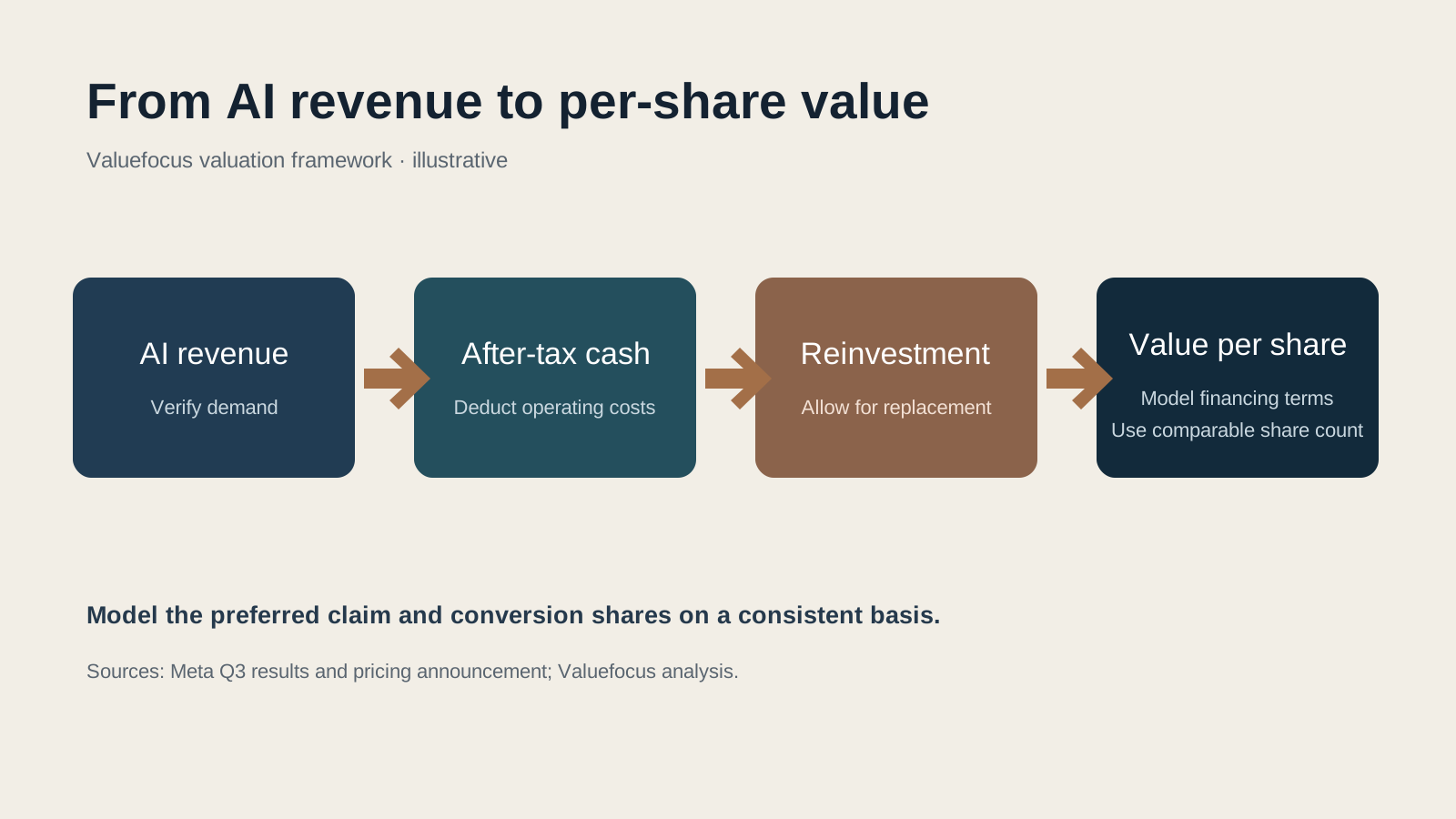
Buffett’s owner-earnings lens asks how much spending it takes to maintain the business’s competitive position. A Damodaran-style discounted cash flow model asks what incremental after-tax cash the new projects can generate after maintenance and growth reinvestment. Include any gains to the ad business as well as displaced ad profit and equipment replacement.
Model common equity and the share count on the same basis. Before preferred conversion, account for the outstanding preferred claim. In an as-converted scenario, count conversion shares and any pre-conversion distributions once; avoid deducting a preferred claim that conversion has already extinguished. If common equity value rises 15% and the comparable share count rises 5%, the implied value per share rises about 9.5%. That is an illustration, not a Meta forecast.
What would change the investment case?
The bullish case depends on Meta’s advertising engine funding early investment and securing infrastructure before it becomes scarce again. The bearish case depends on the timing: issuance arrives first, while utilization and monetization take longer to prove. Over the next few quarters, watch cash spent on AI and asset lives, disclosure of ad profit and new-product revenue, and the net share count after issuances, conversion and buybacks.
Compare the incremental cash return with the capital committed, then test how much reaches each share. Use Valuefocus’s reverse DCF calculator to see the cash-flow growth implied by the current share price, and compare separately modeled dilution scenarios.
Recent posts

















































Frequently asked questions
Has Meta received the full $97.5 billion?
No. The headline total includes a proposed $60 billion ATM program and a $25 billion forward sale with expected proceeds at settlement.
Do non-voting shares dilute existing owners?
Issuing new shares to outside investors can reduce existing shareholders’ proportional economic ownership, even when the share class carries no votes.
Test the cash-flow growth implied by Meta’s share price.
Open reverse DCF