
Deep Analysis10 min read
The Permission Bottleneck: The AI Trade’s Real Ceiling Isn’t Chips — It’s Zoning
Wall Street has spent two years debating whether AI demand is real and whether the chips can be made fast enough. Almost no one is pricing the question that local governments across America are now answering for them: are you even allowed to build the thing? In 2026 the bottleneck on the AI build-out is quietly migrating from silicon to permits — to land, power, water, and the consent of the town next door. Here is what three masters would measure before paying up for the data-center trade.
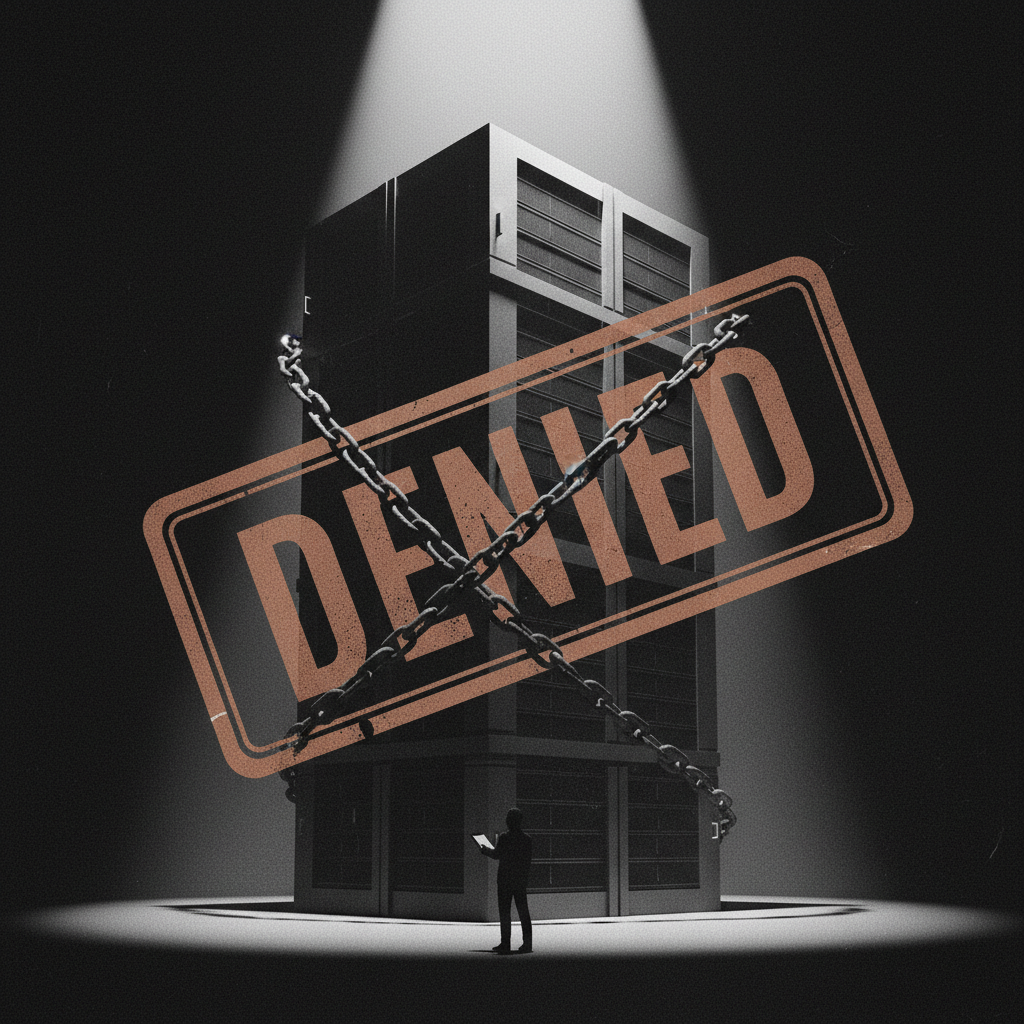
The market is pricing the wrong bottleneck
For two years the AI debate has been fought on two fronts: is the demand real, and can the chips be made fast enough. Both are now largely answered in the bull’s favor — demand is enormous, and Nvidia plus its emerging rivals are shipping. So the market has quietly concluded that the only thing standing between today’s capex guidance and tomorrow’s revenue is execution. That conclusion skips a step.
Because a data center is not a chip. It is a 100-plus-megawatt industrial facility that needs land, a grid connection, water for cooling, and — increasingly — the political consent of the community it lands in. And that consent is being withdrawn. In 2026 alone, at least 63 local data-center moratorium actions have been introduced or considered across the United States, and roughly a dozen states have taken up moratorium or pause legislation. Towns are voting to stop the very thing the market assumes will be built on schedule.
This is the part the spreadsheet leaves out. Capex guidance models the dollars and the chips; it rarely models the permit hearing, the interconnection queue, or the ballot measure. The companion question to our free-cash-flow piece — which asked what is left for shareholders after the spending — has a prequel: what if a large slice of that spending simply cannot be deployed on the assumed timeline, because the answer at the town hall is no?
The grid is the wall behind the wall
Even where the town says yes, the grid may say not yet. Industry reporting in 2026 suggests that nearly half of US data centers planned for the year face delays or cancellation, with power-grid bottlenecks cited as the central cause. Interconnection — the process of actually plugging a gigawatt-scale load into the network — now runs in years, not months, in many regions. You can pour the concrete and rack the GPUs and still sit dark, waiting for power that hasn’t been built.
And the demand math makes the squeeze worse, not better. The Electric Power Research Institute estimates data centers could consume 9–17% of all US electricity by 2030, up from low-single-digits today; Goldman Sachs projects data-center power demand rising as much as 165% by the end of the decade. That is precisely the kind of vertical demand curve that triggers political backlash — over residential electricity prices, water, and noise — which feeds back into more moratoriums. The constraint is self-reinforcing.
Graham: where is the margin of safety if half the pipeline slips?
Benjamin GrahamPay a price low enough that you survive being wrong. The margin of safety is what protects you when the optimistic assumptions don’t hold.
- Graham’s first question is never "how big is the opportunity" but "how much room do I have to be wrong?" When a valuation is built on a build-out completing roughly on schedule, and the public record shows dozens of local bans plus a grid that delays half the pipeline, the honest margin of safety is thinner than the bull case implies — because a real, quantifiable share of planned capacity may simply not come online when modeled.
- He would force the numbers to absorb the friction. Re-run the thesis assuming a meaningful fraction of planned data-center capacity slips by two to three years, or never gets permitted at all. If the investment still makes sense at a price that survives that haircut, it has a genuine margin of safety. If it only works when every permit clears and every interconnection lands on time, you are not investing — you are forecasting a regulatory outcome.
- Graham’s discipline here is unglamorous and decisive: the permission bottleneck doesn’t make AI a bad business; it makes the timing uncertain. And uncertain timing on a capital-intensive thesis is exactly what a margin of safety exists to price. Demand a discount for the delay you cannot see on the calendar.

The capital cycle: everyone is racing into the same constraint
Howard MarksWhen abundant capital floods toward one story, the industry overcommits in unison — and the binding constraint, not the demand, decides the returns.
- Marks watches supply and capital, not the product demo. Right now the most powerful balance sheets on earth are committing three-quarters of a trillion dollars a year into the same physical bottleneck — land, power, and permits — at the same time. When everyone needs the same scarce input simultaneously, the returns don’t accrue to the builders; they accrue to whoever owns the constraint: the utilities, the landowners, the grid.
- This is second-level thinking applied to infrastructure. First-level: "AI needs data centers, so data-center spending is bullish." Second-level: "If everyone builds at once into a power grid that can’t keep up and towns that are voting no, then the marginal data-center dollar earns a far lower return than the model assumes, and the value migrates to the chokepoint." The history rhymes — railroads, fiber, shale: the demand was real every time, and the synchronized build still disappointed on returns.
- Marks wouldn’t call the top — no one can. He would simply note that an industry investing on the assumption of frictionless supply has quietly flipped the asymmetry against the latecomer. The right response is not a forecast but a wider margin of safety on anything whose thesis requires the build-out to clear permitting and power on schedule.
Wall Street is modeling how many chips can be made. The town council is deciding how many data centers can be plugged in. Only one of those numbers is in the spreadsheet.
Munger: invert — list every way the trade dies
Charlie MungerInvert, always invert. Don’t ask how the AI trade wins; ask all the ways it dies, then avoid those.
- Munger’s method is to turn the question upside down. Instead of "how does the data-center build-out succeed?", ask "what are all the ways it fails?" The familiar answers are demand softening and chips commoditizing. But inversion surfaces the unfashionable one that is now climbing the list: the build-out succeeds technically and commercially — and still stalls because it cannot get permission to plug in. Land denied, power queued, water restricted, community opposed.
- Once you see it, you can’t unsee it as a risk concentration. A great deal of the AI bull case quietly assumes near-frictionless deployment of physical infrastructure in a country where local governments are increasingly voting against exactly that. Munger would treat "we have the chips and the customers but not the permits" not as a tail risk but as a named, observable, and spreading failure mode — the kind he insists you avoid rather than underwrite.
- His practical counsel is to invert into a checklist: for any AI-infrastructure exposure, ask which links in the chain you are implicitly betting will clear — zoning, interconnection, water, local politics — and whether the price you’re paying compensates you for the one most likely to break. The trade that survives inversion is the one that still works even if the slowest permit, not the fastest chip, sets the pace.
So what should an ordinary investor actually do?
As always, the masters don’t vote the same way — and that is precisely their use. Graham says re-price the thesis assuming a chunk of the pipeline slips, and demand a discount for it. Marks says watch the synchronized rush into a shared physical constraint, and ask where the value really migrates. Munger says invert — name the permission-and-power failure mode explicitly, and avoid the prices that ignore it. "Is AI infrastructure bullish?" forces a slogan. "Which links in the build-out chain am I betting will clear, and am I paid for that?" gives you something to do.
Concretely: for every AI-infrastructure name you own — hyperscalers, utilities, REITs, power and cooling suppliers — separate the demand story from the deployment story. Is the valuation assuming capacity comes online on schedule (Graham)? Is the whole sector racing into the same grid-and-permit bottleneck at once (Marks)? Have you named the specific way permission or power kills the timeline (Munger)? Notice, too, that the constraint creates winners: whoever owns scarce power, interconnection rights, or permitted land may capture value the builders assumed was theirs.
You don’t have to declare the AI build-out a triumph or a mirage. You have to know whether the business you own is priced as if it can build anywhere, instantly — in a country that is increasingly voting otherwise. Valuefocus’s Master Lens runs exactly these frameworks — margin of safety, the capital cycle, inversion — across any stock on your watchlist, one master at a time.
Recent posts













































Frequently asked questions
What is the "permission bottleneck" in the AI data-center build-out?
It is the cluster of non-technical constraints — local zoning bans and moratoriums, multi-year grid interconnection queues, water and noise restrictions, and community opposition — that can stop or delay a data center even when the demand and the chips are fully available. The market tends to price chip supply and AI demand but rarely models whether a facility can actually get permitted and powered on schedule.
How widespread are data-center moratoriums right now?
Public tracking suggests at least 63 local data-center moratorium actions were introduced or considered across the US in 2026, with roughly a dozen states taking up moratorium or pause legislation. Separately, industry reporting indicates nearly half of US data centers planned for 2026 face delays or cancellation, largely due to power-grid bottlenecks.
How much electricity will data centers actually need?
Forecasts are large: the Electric Power Research Institute estimates data centers could consume 9–17% of US electricity by 2030, and Goldman Sachs projects data-center power demand rising as much as 165% by the end of the decade. That steep curve is itself a driver of the political backlash feeding new moratoriums.
Does this mean AI infrastructure is a bad investment?
No. The frameworks here do not say AI is a bad business; they say the timing and deployment of the physical build-out carry under-priced risk. Graham would re-price for delay, Marks would watch the synchronized rush into a shared constraint, and Munger would name the failure mode explicitly. The point is to demand a margin of safety, not to make a call.
Is this investment advice?
No. This article applies public analytical frameworks to widely reported public information for educational purposes and makes no recommendation about any security.
Stop trading on demand headlines — stress-test the build-out with three master frameworks on any stock in Valuefocus:
Download Valuefocus