
Deep Analysis11 min read
The Dividend Trap: Why FinTok Is Wrong About "Passive Income"
Scroll FinTok this week and the same dream keeps repeating: collect "$100 a month in dividends" from Coca-Cola, Apple and AT&T, sit back, and let the money roll in. The videos rack up hundreds of thousands of likes. But "high yield" and "good investment" are not the same sentence — and the gap between them is where the dividend trap lives. Here is what four master investors would say before you chase the yield.

The viral promise — and the quiet flaw
The format is irresistible. A creator shows three household-name stocks — Coca-Cola, Apple, a telecom like AT&T — adds up their dividend yields, and tells you exactly how much capital you need to "earn" $100 a month doing nothing. It feels concrete, safe, and achievable. That is precisely why it spreads.
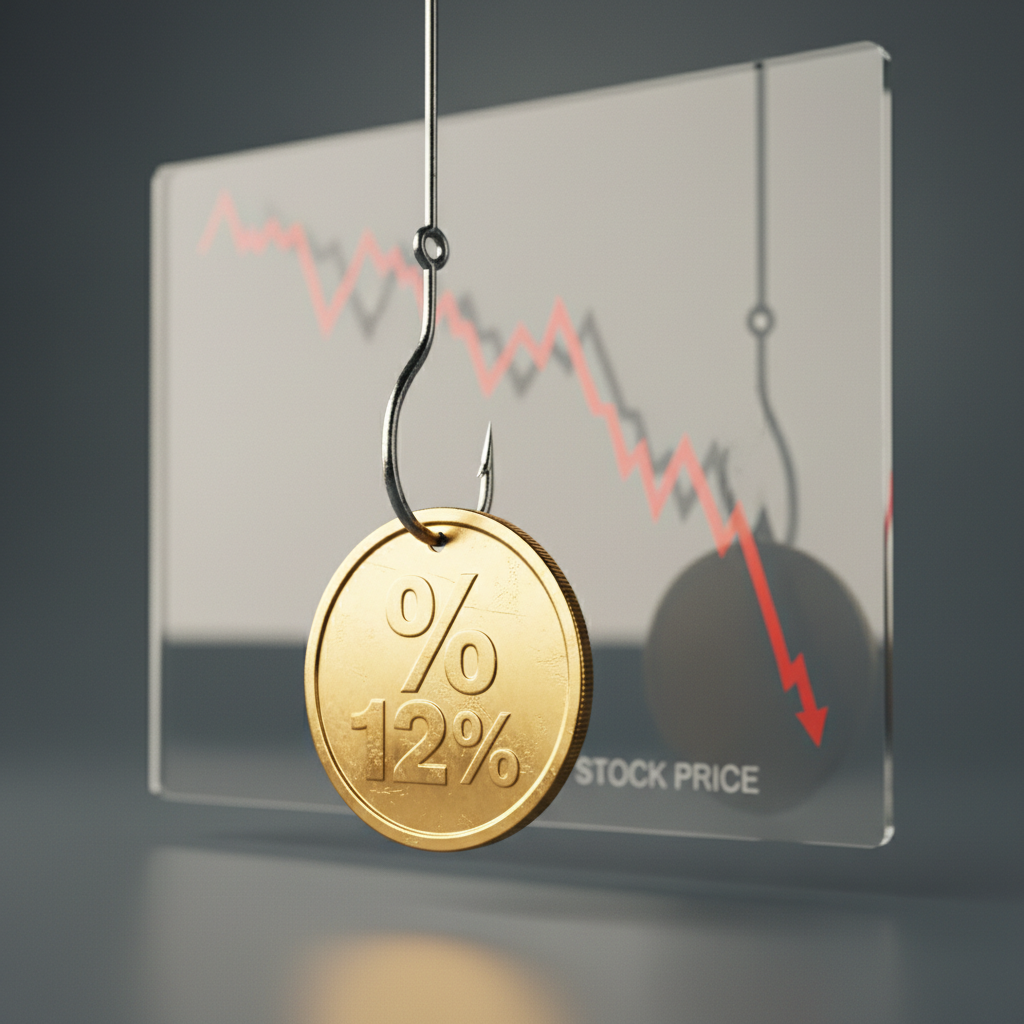
The flaw is hidden in the word "yield." A dividend yield is simply the annual dividend divided by the share price. So when a stock's price falls hard, its yield mechanically rises — and screens light up with a tempting number. The very thing that makes a yield look generous is often the market quietly signalling that the business is in trouble. Chasing the biggest number on the screen is, more often than people realise, chasing the most damaged company.
Graham: a high yield is a question, not an answer

Benjamin GrahamThe market is a voting machine in the short run and a weighing machine in the long run — so weigh the business, don't vote on the yield.
- Graham would never start with the dividend. He would start with the margin of safety: is the price comfortably below what the business is conservatively worth? A fat yield on an overpriced, declining business has no safety in it at all.
- He distinguished investment from speculation by one test — protection of principal. A dividend that arrives while the share price erodes faster than the payout is not income; it is a slow return of your own capital, dressed up as a reward.
- His practical filter: look at whether dividends have been paid consistently for many years AND covered by earnings. Consistency without coverage is a trap waiting to spring.
Buffett: the best dividend is often the one not paid
Warren BuffettA dollar retained must create at least a dollar of market value — otherwise it should be paid out.
- Buffett's most counter-intuitive lesson for FinTok: Berkshire Hathaway has paid a dividend exactly once, and he regrets it. Why? Because a great business can reinvest your dollar at high returns far more powerfully than you can by spending it. Apple's value to long-term owners came overwhelmingly from buybacks and reinvested growth, not its modest yield.
- The right question is not "how much does it pay?" but "what does it do with the money it keeps?" A company earning high returns on retained capital is compounding for you silently. One forced to pay out because it has nowhere good to reinvest is telling you its growth is over.
- So a rising yield from a maturing, low-growth business can be a signal that the economic moat is narrowing — the cash has nowhere better to go than your pocket.

Chasing the highest yield on the screen is, more often than people realise, chasing the most damaged company. The yield went up because the price went down — and the price went down for a reason.
Lynch: check the payout ratio before you check the yield
Peter LynchKnow what you own and why you own it — including whether the dividend can actually survive.
- Lynch's favourite sanity check is the payout ratio: what fraction of earnings is being handed out as dividends? A company paying out 90%, 100% or more of its earnings has no cushion. The first bad year forces a cut — and dividend cuts are usually accompanied by a falling share price, so you lose the income and the capital at once.
- He prized companies whose dividends grew steadily because earnings grew steadily. A growing dividend backed by growing free cash flow is real income. A flat or shaky dividend propped up by borrowing is a countdown clock.
- Telecom and other capital-heavy "yield names" are exactly where this bites: huge infrastructure costs and debt can leave the dividend funded from the balance sheet rather than from profits. That is the textbook dividend trap.
Schloss: read the balance sheet, not the yield headline

Walter SchlossI make money by avoiding losses. Look at the downside first — the upside takes care of itself.
- Schloss compounded for decades by obsessively reading balance sheets and avoiding companies that could go to zero. For a dividend stock, his first question would be: is this payout coming from a fortress balance sheet, or from rising debt?
- A high yield financed by borrowing is the opposite of safety. When the economy turns or rates rise, the debt-funded dividend is the first thing management cuts — and the loyal "passive income" crowd is left holding a stock that has fallen and a cheque that has stopped.
- His discipline is the perfect antidote to FinTok: before you fall in love with a yield, run a simple risk analysis of what happens if earnings drop 30%. If the dividend can't survive that, it was never safe income.
So how should you actually use a dividend?
None of this means dividends are bad — Graham, Buffett, Lynch and Schloss all owned dividend payers. The point is the order of operations. FinTok starts with the yield and works backwards to justify it. The masters start with the business and treat the yield as the last box to tick, not the first reason to buy.
A practical checklist that fits in one breath: First, is the business durable and reasonably priced — does it pass a margin of safety test? Second, is the payout ratio comfortably below 100%, so the dividend survives a bad year? Third, is it funded by free cash flow, not by debt? Only if all three are yes does the yield become a feature rather than a warning. A "safe 7% yield" that fails any of those is not income — it is a value trap with a coupon attached.
The honest version of the FinTok dream is slower and quieter: own a handful of genuinely strong businesses bought at sensible prices, let their growing dividends and reinvested earnings compound, and ignore the screen showing the biggest number. That is how passive income is actually built — not by chasing the yield, but by earning the right to ignore it.
Recent posts









































Frequently asked questions
Is a high dividend yield bad?
Not inherently — but it is a question, not a green light. A yield rises when the price falls, so an unusually high yield often reflects a market that expects trouble. Always check whether earnings and free cash flow comfortably cover the payout before treating the yield as "income".
What is a dividend trap?
A dividend trap is a stock that lures investors with a high yield while the underlying business — and share price — is deteriorating. The dividend gets cut, the price keeps falling, and the investor loses both the income and the capital.
What payout ratio is safe?
There is no universal number, but a payout ratio comfortably below 100% of earnings — and ideally covered by free cash flow — leaves a cushion for bad years. A ratio at or above 100%, or one funded by rising debt, is a warning sign.
Is this investment advice?
No. This article applies public analytical frameworks to publicly discussed examples for educational purposes only and makes no recommendation about any security.
Before you chase a yield, run the business through every master framework in Valuefocus:
Download Valuefocus