
Investing Frameworks11 min read
The $3.5 Trillion "Hidden Debt": The Real Detonator of the AI Bubble Isn't Sky-High Valuations — It's the Leverage Buried Below the Waterline
A new Information Special Report reveals that AI borrowers are tapping a $3.5 trillion private-credit market "hiding in plain sight." When financing shifts from equity to debt, the rules of the game change entirely. Howard Marks' credit cycle, Graham's balance-sheet scrutiny, and Dalio's debt machine explain why this is far more dangerous than a high multiple.
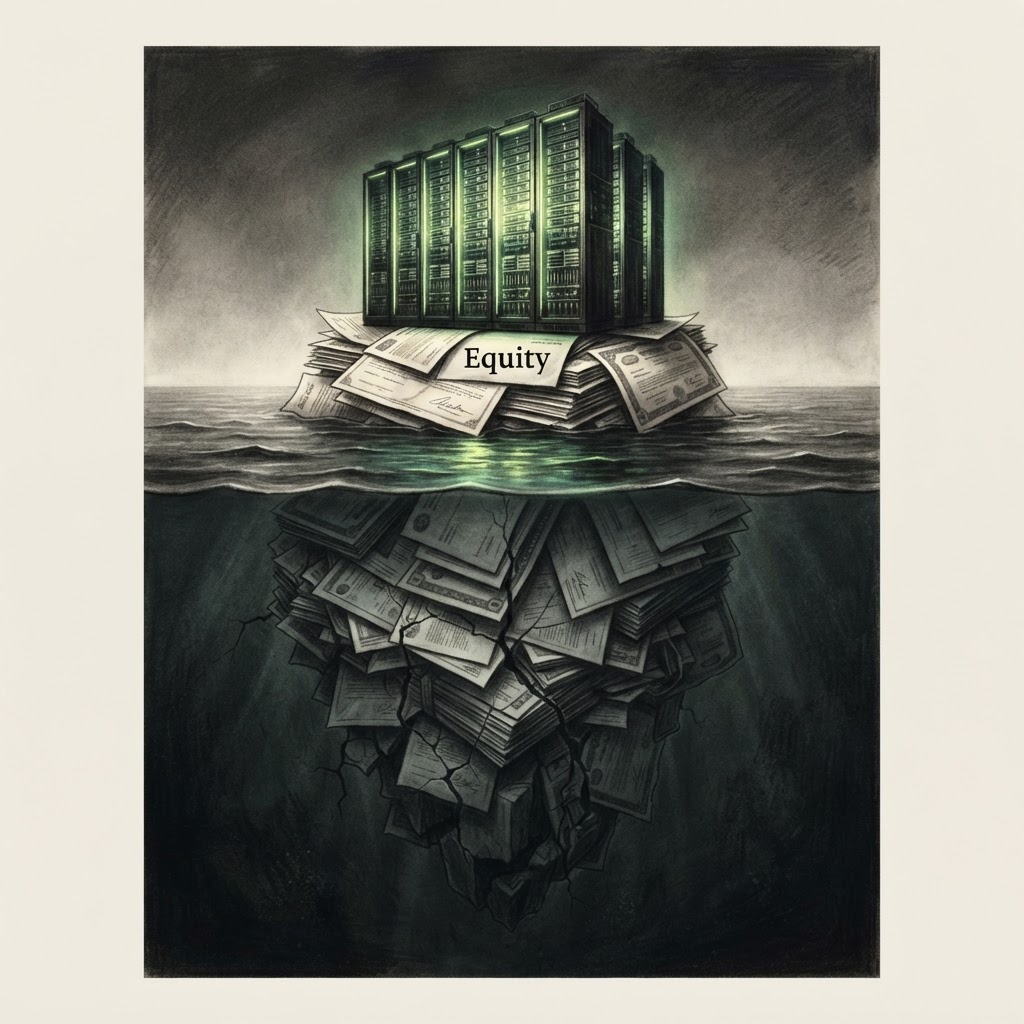
Everyone Is Arguing the Wrong Question: The Bubble's Fuse Isn't in the P/E
Across the summer of 2026, the market has been locked in one endless argument: is AI a bubble? A draft Treasury report compared today's AI investment frenzy to the dot-com bubble, and even Alphabet CEO Sundar Pichai made the rare admission that it is "partly" a bubble. But almost every strand of the debate revolves around a single dimension — valuation. Is Nvidia's multiple justified? Have Microsoft and Meta run too far?
This is a debate asking the wrong question. Because the truly dangerous thing is never where everyone is already looking. A new Information Special Report cut open a deeper wound: AI borrowers are tapping a market worth as much as $3.5 trillion, "hiding in plain sight" — private credit. That means the capital propping up this AI frenzy is quietly being swapped from "equity" to "debt."
That switch is the heart of this article. When a company builds a data center with money raised by issuing shares, the worst case is dilution and a falling stock price. But when it builds with borrowed money, the worst case is default, a pulled credit line, cascading liquidation. The first is an argument about "how expensive"; the second is a ticking bomb about "can it be repaid." And almost no one in the market is seriously doing that second calculation.
From Equity to Debt: Capital Is Quietly Changing Into a More Dangerous Form
The evidence is written into the headlines of the past few days. Bank of America recently extended a $520 million loan to OpenAI — and notably, this is the same bank that sat out OpenAI's 2024 credit line, now stepping in proactively. Blue Origin is raising $10 billion at a $130 billion valuation, its first-ever outside funding. Capital is pouring into AI infrastructure at unprecedented speed, via borrowing rather than diluting equity.
Why debt? Because equity is too expensive and too slow. When public markets start questioning valuations, issuing more stock depresses the price and dilutes existing holders. The private-credit market — a vast pool of pension funds, insurers and private funds — is willing to lend directly to these cash-burning compute projects in exchange for steady interest. For borrowers, it's a shortcut to capital that "doesn't touch the share price."
But shortcuts have a price. Much of this debt is collateralized by data centers, GPUs and similar assets — classic asset-backed financing. The problem: if AI revenue growth fails to keep pace, or if those compute assets depreciate rapidly as technology iterates (a possibility we dissected in another article on capex devouring free cash flow), the collateral value shrinks while the principal and interest stay rigidly due. This is a structural echo of the 2008 subprime crisis — except this time the collateral isn't houses, it's servers.
Howard Marks: We Are Standing at the Loosest, Most Dangerous End of the Credit Cycle
The first master to summon is Howard Marks of Oaktree Capital — a man who built his career buying distressed debt at the troughs of the credit cycle, with an understanding of debt cycles second to none. Marks repeatedly stresses that the credit market is like a window that opens and closes. When the window is wide open, money is cheap, lending standards are loose, and risk premiums are compressed to nothing — precisely the most dangerous moment, because the market is planting the seeds of future defaults.
View today through Marks' cycle lens: a $3.5 trillion private-credit market willing to lend to AI projects whose cash flows are unproven, with banks racing to join in — this is a textbook cluster of "credit window wide open" signals. Marks' famous line: "The most dangerous thing is to believe that risk has disappeared." When everyone assumes AI demand is a certainty and repayment is a non-issue, that is exactly when risk premiums are lowest and vigilance should be highest.
Marks won't tell you the window slams shut tomorrow — no one can time it precisely. But he will interrogate you with his famous question: "Where do we stand in the cycle?" When debt floods into a single narrative at this scale and looseness, you must at least recognize that the pendulum of the credit cycle has swung to its most optimistic — and most fragile — extreme.

Graham: Open the Balance Sheet, and What You See May Be Only the Tip of the Iceberg
The second master is Benjamin Graham, the father of value investing, who would do something plain yet lethal: open the balance sheet and read it, line by line. Graham's lifelong creed was that an investor must think like a creditor — first ask "how much does this company owe, and can it repay," then ask "how much can it earn." He had an instinctive wariness of companies that use complex structures to hide their liabilities.
And the terrifying thing about private credit and asset-backed financing is precisely its invisibility. Much of this debt is held through special-purpose vehicles (SPVs), joint-venture structures or off-balance-sheet arrangements, and may not be fully reflected on the parent's balance sheet. When you open an AI giant's financials, the equity and cash you see may look beautiful — but the real leverage may lie below a waterline you can't see, like the tip of an iceberg that is nowhere near its full mass.
This is the hardest-edged application of Graham's margin of safety: the discount you demand is not only against "earnings may miss expectations," but against "liabilities may exceed what you can see." For today's AI supply chain, Graham-style due diligence means you must actively interrogate the financing structures that don't make the headlines, rather than being led by the numbers on top-line growth.
Ray Dalio: Every Big-Cycle Top Is a Moment When Debt Has Been Stacked to Its Limit
The third master is Ray Dalio of Bridgewater, who sees the economy as a machine driven by debt. Dalio's core insight: short-term debt cycles stack into a long-term debt cycle, and every top of a long-term debt supercycle shares one feature — debt has been piled up relative to income to a level that becomes unsustainable, and then deleveraging is forced to happen, one way or another, gently or violently.
Place the AI financing frenzy inside Dalio's framework: today, enormous debt is being created to chase a grand narrative about future productivity. As long as revenue and confidence keep rising, the machine self-reinforces — borrow more, build more, higher valuations, borrow more again. But Dalio would coldly remind you that this self-reinforcement has an end. Once revenue growth falls short of debt costs, or the credit window tightens, the machine runs in reverse: defaults, sell-offs, credit contraction, each link pulling the next.
Dalio isn't telling you to flee the market today — he admits timing is extraordinarily hard. What he truly wants is for you to understand where in the cycle you stand: the early stage of debt expansion, or the euphoric approach to the top? When a $3.5 trillion hidden credit market becomes the fuel for a tech frenzy, Dalio's machine theory tells you that, at minimum, you should write the word "deleveraging" back onto your risk checklist.
What Ordinary Investors Should Do: Move Your Gaze From the Stock Price to Below the Balance Sheet
So, facing this $3.5 trillion hidden iceberg of debt, what should an ordinary investor do? This article won't give you a buy or sell call — but it wants to hand you a different pair of glasses.
Step one: stop arguing about the bubble using only the P/E ratio. Valuation is one dimension, but debt structure is another, more lethal one. When you study a company deeply entangled in AI capex, force yourself to ask one more question: is the money it builds data centers with shareholders' money, or borrowed? For the borrowed part — what's pledged as collateral, when does it mature, and what happens if it can't be repaid? Step two: stack the three frameworks — use Marks to judge the looseness of the credit window, Graham to scrutinize the liabilities hiding off-balance-sheet, and Dalio to locate your coordinates within the great debt cycle.
This is exactly the habit of mind Valuefocus is built to give you. When all the market's noise is fixated on "will it go up," our social sentiment radar helps you quantify how extreme the euphoria is. Then the master frameworks take over, guiding your gaze below the waterline — using Marks' credit cycle, Graham's balance sheet and Dalio's machine to reduce the vague panic of "the AI bubble" into a concrete, rationally testable question about "just how heavy is the hidden leverage." The real risk usually hides in the places the headlines don't write about.
Recent posts










































Frequently asked questions
What is the "$3.5 trillion hidden debt market" in AI financing?
According to an Information Special Report, AI-linked borrowers are tapping a roughly $3.5 trillion private-credit market to finance data centers and compute expansion. It is "hiding in plain sight" because such debt is often held through private funds, SPVs or off-balance-sheet structures, lacking the transparency of public markets. This article is for educational purposes only and is not investment advice.
Why is debt financing more dangerous than equity financing?
When an equity bubble pops, stocks fall and shareholders are hurt, but the company usually survives. When a debt bubble pops, you face defaults, pulled credit lines and cascading liquidations that can freeze an entire credit chain and damage the whole system. As AI giants shift from issuing shares to large-scale borrowing to build data centers, the nature of the risk changes from "how expensive" to "can it be repaid."
What framework best evaluates debt risk in the AI industry?
Stack three master lenses: Howard Marks on the "credit cycle" — is the window open too wide, are risk premiums compressed too low; Graham on the "balance sheet" — actively hunt for off-sheet and collateralized debt and demand a margin of safety; Ray Dalio on the "great debt cycle" — judge whether you are in the early expansion or the euphoric, deleveraging-risk zone near the top.
The real risk hides in the places the headlines don't write about. Use Valuefocus to reduce "the AI bubble" into a testable question about hidden leverage:
Download Valuefocus