
Deep Analysis11 min read
Who Is Really Paying for the AI Boom? The Circular-Financing Question
The viral thread this week isn't the old "1999 vs now" chart. It's sharper and more uncomfortable: chip makers invest in AI labs, the labs spend it on chips, the chip maker books the revenue — and the market cheers the growth. Critics call it "circular financing." Bulls call it a supply chain. Both are slogans. Here is what four masters would actually check.

The deal map everyone is screenshotting
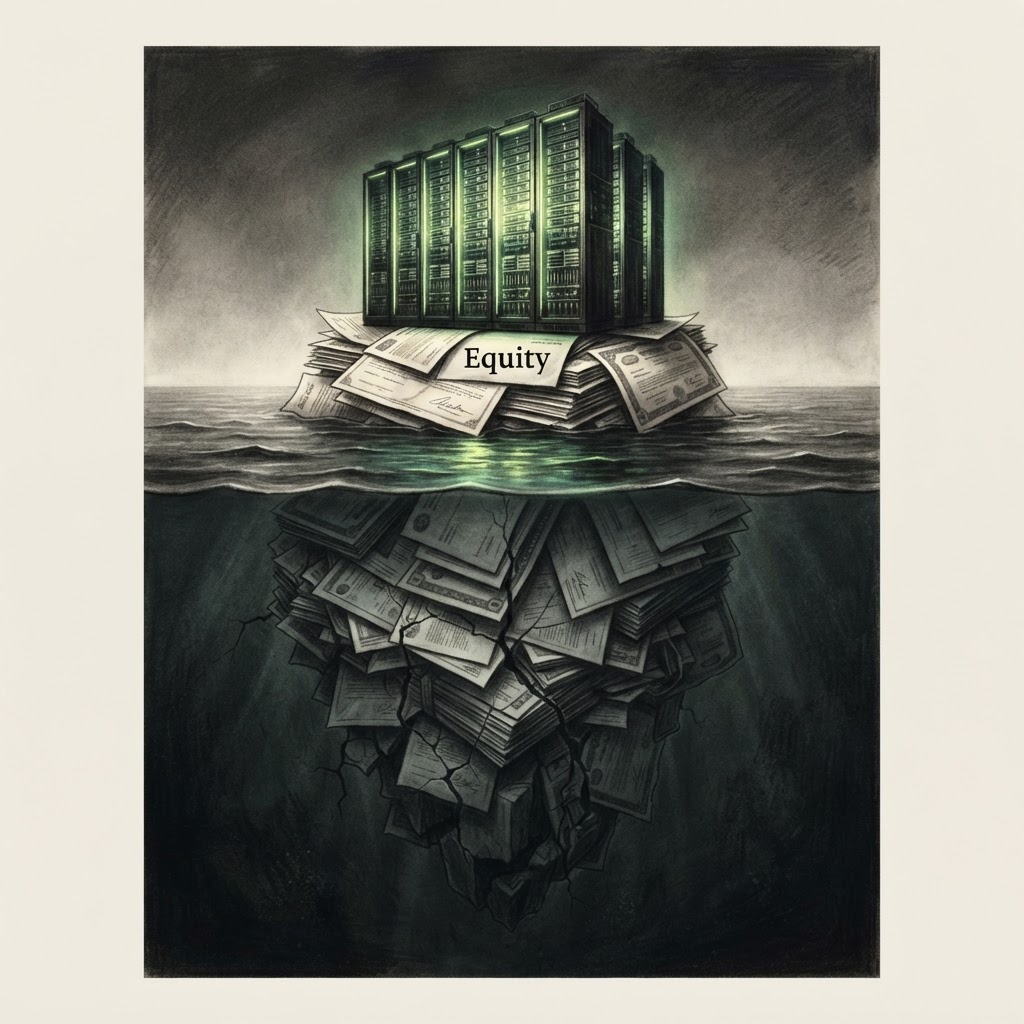
The thread doing the rounds isn't a price chart — it's a diagram of arrows. A chip maker takes a stake in an AI lab; the lab signs a multi-billion-dollar compute commitment; that commitment shows up as the chip maker's revenue; the revenue lifts the chip maker's stock; the higher stock funds the next round. Drawn out, it forms a loop. The provocative claim: a meaningful slice of AI "demand" may be the industry buying from itself.
The bull rebuttal is fair: vertical integration and strategic investment are as old as industry, and real end-demand for compute clearly exists. So the honest version of the question is quantitative, not rhetorical — how much of the headline revenue depends on related-party or vendor-financed deals, and what would the numbers look like if that financing paused? That is not a slogan you shout. It is a figure you go and check, name by name.
Buffett: forget reported profit — what are the owner earnings?
Warren BuffettOwner earnings are reported earnings plus depreciation, minus the capital expenditure truly required to maintain competitive position.
- Buffett's owner-earnings idea was built for exactly this situation. Reported net income flatters businesses that spend enormous amounts on capex, because the spending hits the balance sheet now and the income statement only slowly, through depreciation. AI infrastructure is the most capex-heavy boom in a generation.
- The uncomfortable arithmetic: if a company must keep spending tens of billions just to stay in the race, that spending is maintenance capex, not growth capex — and owner earnings are far below the reported figure. The "profit" headline and the cash a long-term owner could actually pocket can diverge sharply.
- His test here is brutal and clarifying: would this business generate cash for its owners if it stopped expanding tomorrow? For a genuinely durable franchise, yes. For one that must outspend rivals every year merely to stand still, the honest answer is closer to no.
The capital cycle: free money builds the thing that kills the returns

Howard MarksCapital availability runs in cycles. When money is free and the story is loud, supply gets overbuilt — and the cure for high returns is high returns.
- The capital-cycle lens ignores the product and watches the money: when capital floods into an industry, competitors overbuild capacity, and the very abundance that funds today's growth seeds tomorrow's oversupply. Fibre in 1999, shale in the 2010s, datacenters now — the pattern rhymes because the incentive does.
- Right now the cycle gauge is pinned at maximum generosity: record funding rounds, hundred-billion-dollar compute commitments, and infrastructure being built ahead of proven demand. That is the textbook condition for strong reported growth followed by underwhelming returns on the capital deployed.
- Marks would not predict the timing — no one can. He would prepare: when an entire industry is investing on the assumption that demand only goes up, the asymmetry has quietly flipped. Being early to caution feels wrong right up until it feels obvious.

The arrows that look like a thriving supply chain on the way up look like a circle of dependence on the way down. The difference is only visible in the cash — not the narrative.
Klarman: read the footnotes, then demand a bigger margin
Seth KlarmanMargin of safety grows from rigorous, skeptical analysis — especially of the things management would rather you not examine.
- Klarman lives in the footnotes. Two questions decide a lot here: over how many years is the AI hardware being depreciated, and how much revenue is tied to vendor financing or related parties? Stretch the depreciation schedule and today's profit rises while the economic truth doesn't change at all.
- Where reported numbers depend on aggressive assumptions or self-funded demand, his response is not to avoid the sector — it is to widen the discount you require. Uncertainty is not a reason to pay full price more carefully; it is a reason to pay much less.
- His deeper warning is about reflexivity: when rising stock prices are themselves financing the next round of "demand," the whole structure is more fragile than any single income statement reveals. A margin of safety is what lets you survive being wrong about something you couldn't fully see.
Fisher: which demand is durable, and which is rented?
Philip FisherA premium is justified only by growth that is genuinely durable — not by growth that is bought.
- Fisher is the bull's best advocate and its strictest examiner. He would happily pay up for a company whose AI demand is real, recurring, and rooted in a product customers can't do without. The multiple is not the issue; the durability behind it is.
- So he splits the field: which players sell into broad, paying, repeat end-demand — and which book impressive revenue that is ultimately financed by the seller or a tightly linked partner? The first kind earns its premium. The second is renting a lead with someone else's balance sheet.
- The Fisher discipline applied to circular deals: trace the cash to a genuinely independent customer. If the chain of demand loops back to the seller within a step or two, you are not looking at durable growth — you are looking at a story that needs the music to keep playing.
So what should an ordinary investor actually do?
Again, the masters don't vote the same way — and that is the use of them. Buffett says measure owner earnings, not reported profit. The capital cycle says watch supply, not just the product. Klarman says read the footnotes and widen your discount. Fisher says trace the demand to a real, independent customer. "Is AI circular financing a scam or a supply chain?" forces a single answer; "which of these four risks does my holding actually carry?" gives you something to act on.
Concretely: for each AI-exposed name you own — directly or through an index — write the one sentence that must stay true for the price to make sense, then stress it. Does the company still generate cash if it stops expanding (Buffett)? Is the whole industry overbuilding on free capital (capital cycle)? Are the earnings real after the footnotes (Klarman)? Is the demand independent of the seller (Fisher)? If you can't answer with observable facts, size the position like the guess it is.
You don't have to declare the boom fake or real. You have to know which lens each holding lives or dies by — and Valuefocus's Master Lens runs exactly these frameworks across any stock on your watchlist, one master at a time.
Recent posts















































Frequently asked questions
What is "circular financing" in AI?
It refers to a pattern where companies in the AI supply chain invest in each other and then transact, so that one company's investment can show up as another's revenue. It isn't inherently improper, but it can inflate reported demand growth without adding genuinely independent end customers — which is why analysts trace how much revenue is related-party or vendor-financed.
Why do owner earnings matter more than reported profit here?
Because AI is extraordinarily capex-heavy. Reported profit can look healthy while almost all the cash is consumed by the spending needed just to stay competitive. Buffett's owner-earnings adjustment subtracts that maintenance capex to reveal what a long-term owner could actually keep.
Is this the same argument as "AI is a 1999 bubble"?
No — it is a sharper, more checkable version. Rather than debating a slogan, it asks specific, quantitative questions about cash flow, depreciation, and the source of demand. You can read our companion piece on the 1999 comparison for the valuation-and-narrative angle.
Is this investment advice?
No. This article applies public analytical frameworks to public information for educational purposes and makes no recommendation about any security.
Stop arguing about the diagram — run owner earnings and four master frameworks on any stock in Valuefocus:
Download Valuefocus