
Capital Allocation & Valuation6 min read
enAI Buys a Travel Startup. Will Booking Save on Ads or Pay a New Commission?
AI can take over trip planning. The impact on Booking Holdings depends on which channel its agent bookings would otherwise have used.

ew entry point with two effects on profit
On November 10, The Information reported that OpenAI acquired travel AI startup Odessia and that its founder would join OpenAI. The price and future commercial terms have not been disclosed. Booking investors face a specific question. When travelers use chat to compare hotels and plan trips, will the booking bypass Booking Holdings or go through it? If both paths emerge, the cost of obtaining each booking matters. The Information · TechCrunch
On November 3, Booking reported $54.5 billion of Q3 gross bookings, up 10% year over year, and 345 million room nights. Marketing expense was 4.8% of gross bookings. Direct bookings accounted for a mid-fifties percentage of total room nights over the trailing four quarters. The room-night share does not reveal direct’s dollar share. Group marketing expense is also a blended figure and cannot price marginal acquisition. Booking’s SEC filing
re would the booking have come from?
Separate three cases. An agent can save Booking money if it replaces a paid-search click and charges less than the acquisition cost. It can add an expense if it collects a fee on an order the traveler would have made directly in the app. It can also deliver truly incremental demand from someone who would not have used Booking. All three can show up as agent bookings while contributing differently to profit.
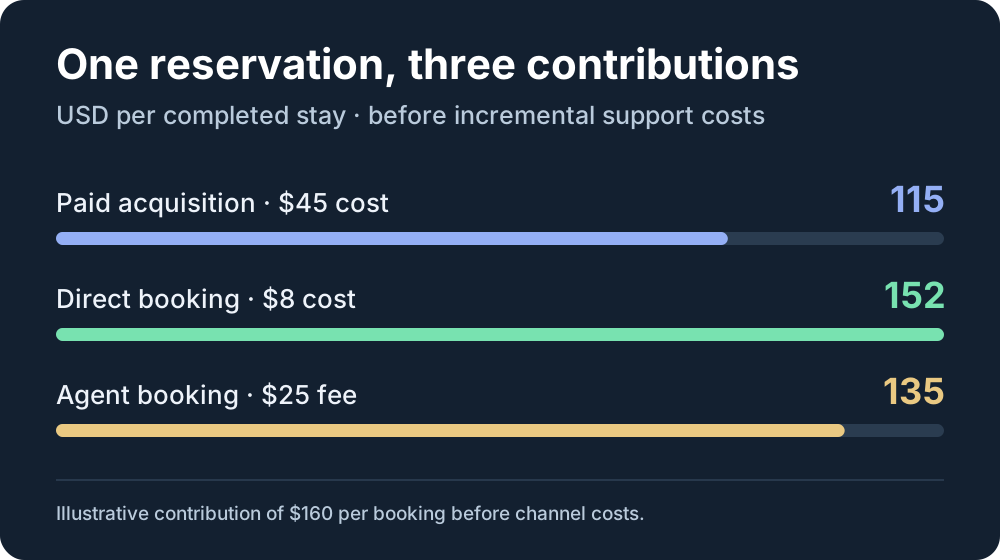
Take an illustrative completed reservation that contributes $160 before acquisition and extra service costs. If paid acquisition costs $45 at the margin, direct costs $8 and the agent charges $25, the three contributions are $115, $152 and $135. Replacing paid traffic adds $20. Replacing direct loses $17. These are scenario inputs, not Booking or OpenAI rates.
If every agent booking comes from one of those existing channels and all else stays equal, roughly 46% must come from paid traffic to break even. The calculation is 17 ÷ (20 + 17). Add $5 of incremental service costs, and replacing paid traffic gains just $15 while replacing direct costs $22. The hurdle rises to about 59%. An identical agent booking count can mean the opposite for profit if its origins or support costs change.
Group marketing intensity is only a scale check. If agents are especially attractive to people already used to opening a booking app directly, commissions can exceed the spending displaced. Where a platform repeatedly bids for keywords and competes for each search, a new entry point may lower acquisition costs. Compare markets and traveler groups using marginal costs rather than a group average.
nning is only the first half of the transaction
Knowing a destination and budget does not reveal a live, bookable room. The rest includes availability, taxes, discounts, payment, cancellations and changes. An agent may understand preferences well, while a platform may win the booking on inventory, local operations and support. Ask who controls inventory and settlement, who handles cancellations and service, and who can reach the same traveler next time.
Supplying inventory to an agent can preserve distribution revenue. Booking may have less of the customer relationship and fewer chances to turn the first reservation into a repeat direct one. A partnership that preserves Booking loyalty benefits and makes changes through Booking may be worth more than a wholesale transaction. Identical first-order economics can support different long-run contribution when repeat behavior, support and data visibility differ.
A Buffett-style owner-earnings lens emphasizes cash left after the spending needed to retain demand and fulfill orders. Part of direct’s value is that repeat visitors do not require another paid acquisition. Alongside gross bookings, ask how many reservations lead to lower-cost repeats. If the agent reallocates the traveler each time, the platform may have to pay again for the same people.
Price cancellations and changes separately. Out of 100 initial reservations, travelers sourced through agents may shop around and cancel more often. Fewer stays are completed, but support and refunds can already have cost money. If an agent collects a fee on the initial reservation and keeps it after cancellation, commission per completed stay rises. Use fulfilled bookings after cancellations as the denominator and account for cancellation handling separately.
data points that would change the valuation first
First, watch channel mix. Compare direct room-night share, marketing spending and bookings. Falling marketing intensity alongside steady direct share and rising bookings is consistent with incremental demand or cheaper acquisition. If bookings grow while direct share keeps falling, examine commissions and service expenses to see how much cash the scale leaves. Exchange rates, market mix and promotions can move these measures too.
Genuinely incremental orders need evidence too. Look for new customers in markets with weaker platform reach and test whether total bookings rise beyond trend and comparable markets after agents go live. If agent share grows while other channels lose a similar volume, redistribution is a stronger explanation. Even genuinely incremental orders can differ in size, repeats and support needs. The existing average margin is a weak shortcut.
Read our analysis of Amazon’s response to shopping agents
Second, watch verifiable partnership terms, particularly control of settlement, changes and repeat purchases. In Valuefocus, run two reverse DCFs. In one, agents mainly replace paid acquisition. In the other, they mainly divert direct bookings. Change acquisition cost, service cost and repeat behavior separately, then ask which booking mix can sustain the margin implied by the market. Open Valuefocus Reverse DCF
Sources and photo credits
Recent posts



















































Test the cash-flow assumptions from the article in Valuefocus.
Open Reverse DCF