
Investing Frameworks10 min read
The €41.50 Question: Why Would a Company Already Growing 25% Spend $14.8 Billion to Buy Its Rival?
On July 16, 2026, Uber agreed to acquire Delivery Hero for €41.50 a share, ~$14.8 billion, across roughly 50 markets, with analysts projecting ~$1.2 billion in synergies (mostly from headcount cuts and tech migration). Yet Uber's own Q1 trips still grew +20% and gross bookings hit $53.7B, up 25%. Using Buffett's M&A discipline, Peter Lynch's "diworsification," and Damodaran's synergy skepticism, we decode "buying growth" — the most expensive trap in the market.
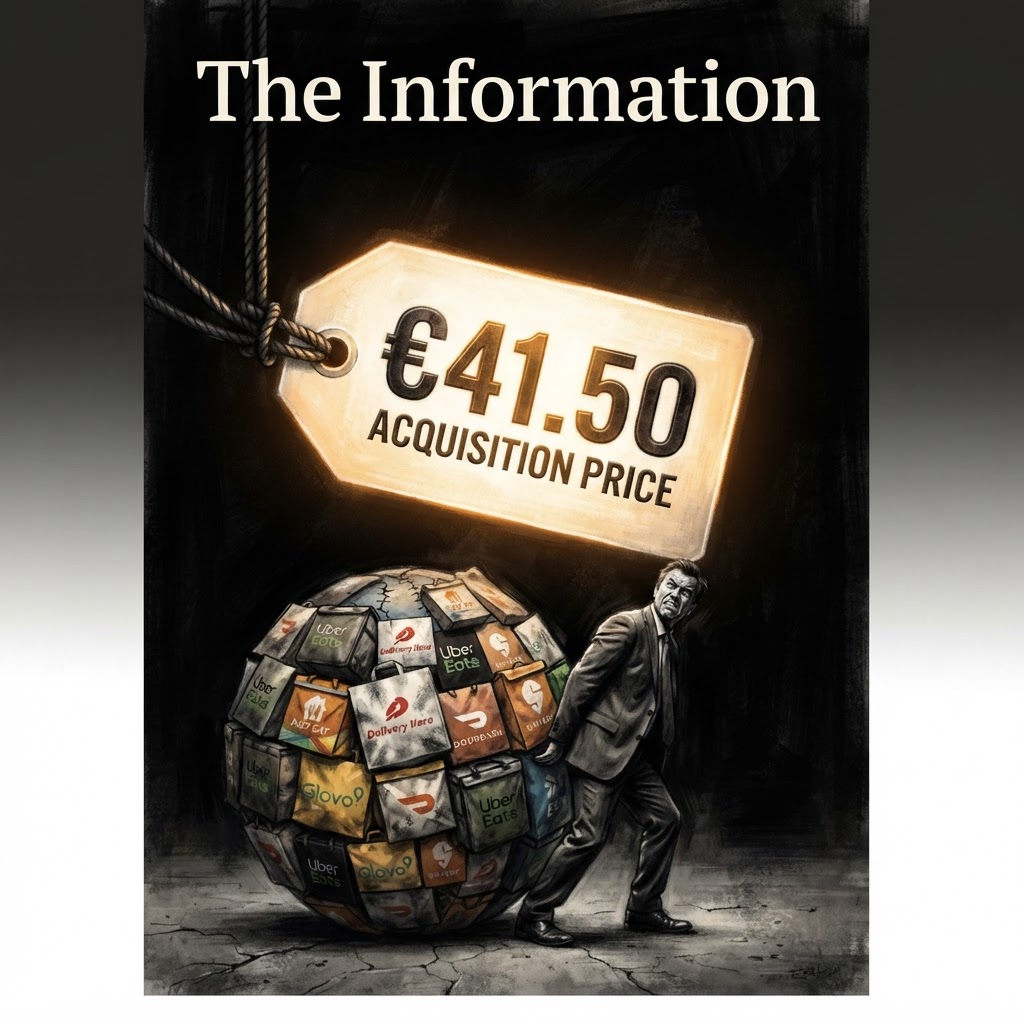
An Offer 26% Higher Than It Was Two Months Ago
On July 16, 2026, Uber announced it had agreed to acquire German delivery giant Delivery Hero for €41.50 a share in cash — roughly $14.8 billion (an equity value near €13 billion) — expanding its footprint to about 50 markets and creating one of the largest food-delivery groups in the world. On the day the news broke, Uber's CEO went on camera and framed the deal as a "disruptive" strategic move.
But the truly telling part is the trajectory of the price. Just two months earlier, in May, Uber's indicative offer was €33 a share — at the time, that was even a slight discount to Delivery Hero's market price. In the span of two months, the final agreed price jumped to €41.50, a rise of about 26%. In the world of M&A, an ever-rising bid usually reveals less about how much the target is worth than about how badly the buyer wants it.
This is exactly where a value investor should hit pause. The market's social sentiment will cheer the grand narrative of the "world's largest delivery empire." But the real question isn't how big the deal is — it's why a company whose own business is still growing fast would pay an escalating price to buy a rival. This article won't tell you to buy or sell anything; it wants to hand you a thinking tool for evaluating "big deals."
The "Buying Growth" Paradox: When You Don't Lack Growth
Start with Uber's own report card. In Q1, its trips grew 20% year-over-year to 3.6 billion; gross bookings reached $53.7 billion, up 25%. This is not a company whose growth has stalled and needs an acquisition to keep it alive — on the contrary, it is in the middle of strong organic growth.
And that surfaces one of the most dangerous kinds of M&A: a company that doesn't lack growth reaching for a fortune to "buy growth." When organic growth is still healthy, a large acquisition often brings not acceleration but dilution — management's attention scattered across integrating 50 new markets, the balance sheet stretched, and the "growth" it buys is really just moving someone else's revenue onto its own books. Real value creation is never a bigger revenue number; it is thicker owner earnings per share.
Delivery, moreover, is a famously hard business to make money in — low margins, heavy subsidies, brutal price wars. Merge two players both burning cash to grab share, and yes, the scale gets bigger, but unless the synergies land in hard dollars, what you get may just be a larger pile that is still hard to make profitable.
Peter Lynch: Beware "Diworsification"
Back in 1989, Peter Lynch coined a word for exactly this phenomenon — "diworsification": a company spreading itself thin through acquisition after acquisition, and ending up not stronger but weaker, more scattered, and harder to manage. Lynch listed it among the danger signs investors should watch most closely.
Lynch's logic is simple: when a company starts acquiring frequently — especially to tell a bigger growth story — investors should be extra careful. Every large acquisition brings integration risk, culture clash, management distraction, and — most lethal of all — overpaying a premium for "synergies." Lynch preferred companies that are focused, simple, and do one thing exceptionally well, not "empire-builders" endlessly stretching themselves.
The lesson for the ordinary investor: when a company you own announces a footprint-changing acquisition, don't get excited by the grand narrative first. Ask three plain questions — is its own core business still healthy? Is the price it's paying reasonable? How hard is the integration? If the core business is already strong, would that money be better spent on buybacks, dividends, or investing in itself than on a hard-to-manage pile?

Buffett's M&A Discipline + Damodaran's Synergy Skepticism
Buffett holds a nearly cold-blooded discipline on acquisitions: most deals destroy shareholder value, because CEOs tend to bid with "animal spirits" and a "must-have" urge rather than sober calculation. He has a famous metaphor: many CEOs are like the princess in the fairy tale, believing that if they kiss enough toads (acquire enough companies), one will surely turn into a prince. Reality: the toads usually stay toads. Buffett would ask — after this deal, is Uber's intrinsic value per share higher or lower? An ever-rising bid is precisely the signal he watches most warily.
Damodaran (Aswath Damodaran) supplies the concrete valuation scalpel. He stresses repeatedly: synergy is the most-sold and least-delivered number in any M&A story. The ~$1.2 billion of synergies analysts expect here come mostly from headcount cuts and tech migration — that sounds lovely, but "cost synergies" require painful layoffs and integration to realize, and "revenue synergies" are usually a mirage. Damodaran's method: apply a big discount to management's claimed synergies, subtract the premium overpaid to win the deal, and see whether the value creation that remains is positive or negative.
Stack the two masters: Buffett makes you wary of the "must-have" urge behind an escalating bid, and Damodaran helps you convert "synergy," the most seductive number of all, back into reality. When the market can only cheer the scale of "the world's largest," this discipline keeps your eyes on what actually matters — value per share.
The Ordinary Investor's Three-Step "Big-Deal Check"
Facing a footprint-changing acquisition, an ordinary investor doesn't need to become an M&A expert — you just need to turn it into a check you can run yourself.
Step one: check the price trajectory. See whether the buyer landed it by repeatedly raising the bid (Uber went from €33 to €41.50, +26%). An ever-rising offer is often a signal of "must-have" overpowering reason. Step two: run a reverse-DCF stress test — halve management's claimed synergies, assume integration drags and costs overrun, recompute post-deal earnings per share, and see whether the deal is accretive or dilutive. Step three: ask the opportunity cost — if the buyer hadn't done the deal, would that money spent on buybacks, dividends, or the core business have done more for intrinsic value?
This is exactly the instinct Valuefocus is built to give you. When everyone is cheering the "world's largest delivery empire," our intrinsic value calculator lets you fold synergies and the premium into the math and see whether value per share actually rises or falls. Then the master frameworks take over, guiding you through Lynch's "diworsification," Buffett's M&A discipline, and Damodaran's synergy skepticism to answer the core question — is this strategic vision, or empire-building value destruction?
Recent posts












































Frequently asked questions
What are "empire-building" and "diworsification"?
"Empire-building" describes a string of acquisitions made to enlarge a company's footprint rather than to create shareholder value. "Diworsification," a term Peter Lynch coined in 1989, describes a company spreading itself thin through M&A until it becomes weaker, more scattered, and harder to manage. Be especially wary when a company whose own growth is healthy spends a fortune to "buy growth." This article is educational only and is not investment advice.
Why is an "ever-rising offer" a danger sign?
Uber's bid for Delivery Hero climbed from ~€33 a share in May to a final €41.50 — a rise of about 26%. In M&A, an ever-rising offer usually reveals less about how much the target is worth than about how badly the buyer wants it — and Buffett warns repeatedly that it is precisely this "must-have" urge that makes most acquisitions destroy shareholder value.
What framework best evaluates large acquisitions?
Stack three master lenses: Peter Lynch — beware "diworsification"; ask whether the core business is healthy, the price reasonable, the integration hard. Buffett — most acquisitions destroy value; watch intrinsic value per share after the deal and beware the urge to keep raising the bid. Damodaran — synergies are most often over-estimated; discount them, subtract the premium, and see whether the value creation that remains is positive or negative.
Is this strategic vision, or empire-building value destruction? Use Valuefocus to fold synergies and the premium into the math and run a calm big-deal check:
Download Valuefocus