
Benjamin Graham
The father of value investing (1894–1976) — the man who turned security selection from speculation into a teachable discipline built on analysis and margin of safety.
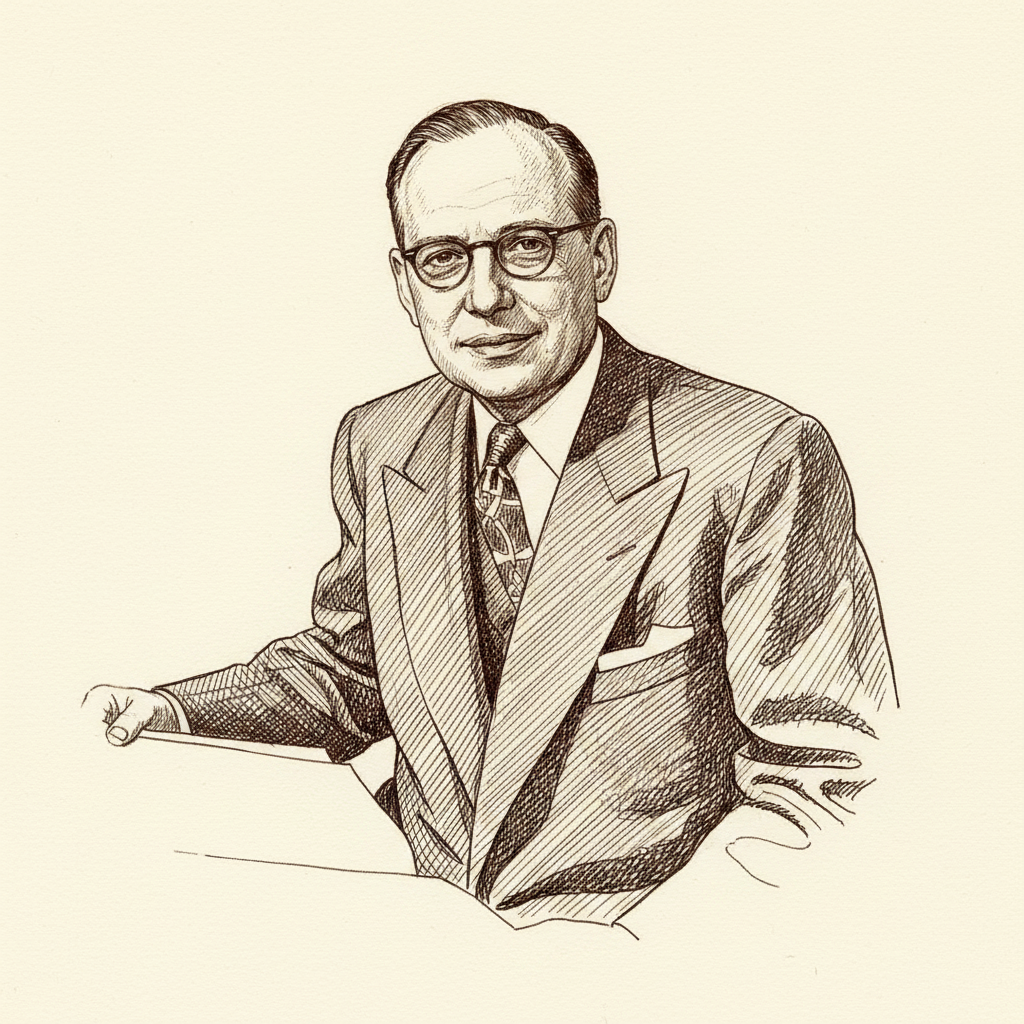
Who he was

Benjamin Graham survived the 1929 crash as a money manager — an experience that scarred and shaped him — and distilled the lessons into two foundational books: "Security Analysis" (1934, with David Dodd) and "The Intelligent Investor" (1949). Teaching at Columbia Business School, he trained a generation of investors, most famously Warren Buffett.
Before Graham, buying stocks was largely tips and tape-reading. After him, it could be a discipline: analyze the business, estimate its value, and act only when price offers a sufficient discount.
Core philosophy
Graham's framework rests on three ideas. First, a stock is a fractional ownership of a real business, not a ticker symbol. Second, the market is a voting machine in the short run and a weighing machine in the long run — embodied in the Mr. Market parable. Third, the margin of safety: because analysis is fallible, only buy at a substantial discount to estimated value.
He also drew the foundational line between investment and speculation: "An investment operation is one which, upon thorough analysis, promises safety of principal and an adequate return. Operations not meeting these requirements are speculative."
Key lessons for individual investors
- The investor's chief problem — and even his worst enemy — is likely to be himself.
- Price is what you pay; value is what you must estimate independently before looking at the price.
- Margin of safety is the central concept of investment — the three most important words in the field.
- You are neither right nor wrong because the crowd disagrees with you; you are right because your data and reasoning are right.
- Distinguish the defensive investor from the enterprising one, and be honest about which you are willing to be.
Benjamin Graham stocks — net-net & deep value picks
Graham's most famous screen is the "net-net": buy a stock for less than its net current asset value (NCAV) — current assets minus all liabilities — ideally at two-thirds of NCAV or less. At that price you are paying nothing for the factories, the brand, or the future; the liquidation value alone covers your purchase. Graham-Newman ran diversified baskets of dozens of such stocks, because any single net-net can fail but a basket of statistical bargains rarely did.
For the "defensive investor," Graham proposed stricter quality criteria in The Intelligent Investor. Both screens share one idea: pay so little that you do not need the future to be kind.
| Graham screen | The rule | The logic |
|---|---|---|
| Net-net (NCAV) | Price ≤ 2/3 × (current assets − total liabilities) | Liquidation value alone covers the price |
| Earnings yield | E/P at least 2× the AAA bond yield | A stock must beat the safe alternative by a wide margin |
| Balance-sheet test | Current ratio > 2; debt < net current assets | Survive first, compound second |
| Earnings record | 10 years of positive earnings; 33%+ EPS growth over 10 years | Avoid chronic losers and fads |
| Price caps | P/E ≤ 15 and P/B ≤ 1.5 (or P/E × P/B ≤ 22.5) | A mechanical ceiling on what you pay |
Rules from Security Analysis (1934) and The Intelligent Investor (1949). Educational framework — not investment advice.
Famous Graham picks and what they showed
- Northern Pipe Line (1926): railroad-bond assets worth $95 per share against an $65 stock — the original hidden-asset activist campaign.
- GEICO (1948): the great exception — a quality growth pick at 25% of the fund that out-earned every net-net combined.
- Diversified net-net baskets at Graham-Newman: ≈20%/yr across depression, war, and recovery.
- The lesson Buffett drew: Graham's method protects the downside; pairing it with quality (Fisher/Munger) unlocks the upside.
Case deep-dive I: Northern Pipe Line, 1926 — the first activist campaign

Digging through obscure ICC regulatory filings, Graham discovered that Northern Pipe Line — a sleepy oil-transport company trading at $65 — held railroad bonds and other liquid assets worth about $95 per share. The value was real, audited, and simply ignored, because no one read the documents.
Management refused to distribute the surplus, so Graham spent two years acquiring shares and soliciting proxies, eventually winning board seats and forcing a distribution of roughly $70 per share to owners. It was the first modern shareholder-activist campaign — conducted with arithmetic rather than rhetoric.
The case crystallized his doctrine: the market can ignore value, but ownership confers the legal power to unlock it. An investor who reads what others skip is, in effect, paid for the reading.
| Stage | What he did | Repeatable action |
|---|---|---|
| Signal | ICC filings showed $95/share of liquid assets behind a $65 stock | Read the primary documents nobody else opens |
| Verify | The assets were audited railroad bonds — real and realizable | Confirm hidden value is both genuine and convertible to cash |
| Size | Accumulated shares and solicited proxies for two years | When value is trapped, ownership rights are part of the toolkit |
| Exit & result | Won board seats; forced ≈$70/share distribution to owners | Unlock value actively instead of waiting passively |
Case deep-dive II: GEICO, 1948 — the exception that proved the rules

In 1948 Graham-Newman bought half of GEICO, a small insurer selling directly to safe drivers by mail, for $712,000 — about 25% of the fund's assets, a flagrant breach of Graham's own diversification rules. Forced by regulation to distribute the shares to fund investors, those who simply kept them watched the position grow more than 200-fold over the next quarter century.
Graham noted the irony in his memoirs: this single growth company, held passively, earned more than the thousands of diversified bargain operations his firm executed over decades. He never rewrote his rules — but he recorded the evidence honestly.
For students, the case is a bridge: Graham's margin of safety applies not only to asset values but to franchises bought early at sensible prices — the path his student Buffett would walk.
| Stage | What he did | Repeatable action |
|---|---|---|
| Signal | Direct-mail selling gave GEICO a structural cost advantage | Recognize business-model-level advantages, not just statistical cheapness |
| Verify | Deep diligence culminating in buying half the company | A major exception demands diligence far beyond the routine |
| Size | $712K ≈ 25% of the fund — a flagrant breach of his own rules | Break a rule only on overwhelming facts, and record it honestly |
| Exit & result | Passive holders earned 200×+ over 25 years | With an outstanding business, the best action is often no action |
Graham's classic playbook, step by step
- Screen systematically for statistical cheapness — net-nets and stocks below conservative asset value.
- Verify asset quality in the primary filings: cash, receivables, inventory, debt — line by line.
- Buy by the basket: dozens of positions, so no single disappointment matters.
- Sell each as price returns to fair value, and roll into the next bargain.
- When value stays trapped, use shareholder rights — proxies, board seats, distributions.
Practical takeaways from Graham's casebook
- Primary documents are alpha: the Northern Pipe Line value sat in public filings nobody opened.
- Shareholders are owners — when value is trapped, governance is part of the toolkit.
- Record your exceptions honestly: Graham's best trade broke his own rules, and he said so.
- Diversify the statistical bets; concentrate only when the facts are overwhelming.
Track record & famous decisions
| Year / Period | Decision | Outcome |
|---|---|---|
| 1926–56 | Graham-Newman Corporation | ≈20%/yr through depression and war |
| 1948 | GEICO — $712K, ≈25% of the fund | grew 200×+; exceeded all other profits combined |
| 1934 / 1949 | Security Analysis & The Intelligent Investor | the founding texts of value investing |
In their own words
- "In the short run the market is a voting machine; in the long run, a weighing machine."
- "The three most important words in investing: margin of safety."
- "The investor's chief problem — and even his worst enemy — is likely to be himself."
Key facts
Last updated: June 18, 2026- Graham's signature "net-net" screen buys a stock below its net current asset value (NCAV) — ideally at two-thirds of NCAV or less.
- His defensive-investor price caps: P/E ≤ 15 and P/B ≤ 1.5 (or P/E × P/B ≤ 22.5).
- Graham-Newman ran diversified baskets of net-nets returning roughly 20% per year across depression, war and recovery.
- Rules documented in Security Analysis (1934) and The Intelligent Investor (1949).
Valuefocus, "Benjamin Graham" (Last updated: June 18, 2026), https://valuefocus.io/masters/benjamin-graham
Ask Benjamin Graham a question
Type a question about Benjamin Graham's classic investment theories, or pick one below.
The exception that beat all the rules
In 1948, Graham-Newman put about $712,000 — close to a quarter of the fund — into GEICO, an insurer that sold directly to careful drivers by mail and skipped the agent entirely. The position broke Graham's own diversification rules, and regulators even forced the fund to distribute the shares to its investors.
Those who kept the shares watched them grow more than two hundred-fold. Graham, the great apostle of wide diversification and statistical bargains, admitted in his memoirs that this single decision earned more than all the profits from twenty years of his diversified operations combined.
Even the father of quantitative bargains conceded: one outstanding business, deeply understood, can outweigh a career of small edges.

Buying a dollar for fifty cents — by the basket
Graham's signature operation was mechanical and unglamorous: buy companies trading below their "net-net" working capital — cash, receivables and inventory minus every liability — so the buyer effectively paid nothing for the factories, the brand or the future. Each one was a discarded cigar butt with one free puff left.
Any single net-net could disappoint, so Graham never relied on one: Graham-Newman held dozens at a time, selling each as it returned to fair value. Across three decades, through depression aftermath and war, the diversified baskets earned roughly 20% a year — built from stocks nobody else wanted.
A screen's edge comes from discipline and diversification across the basket — not from any single thrilling pick.

Buying everything under a dollar as the world went to war
In 1939, as war broke out in Europe and pessimism was total, young John Templeton borrowed $10,000 and placed one order: 100 shares of every NYSE and AMEX stock trading below $1 — 104 companies, 34 of them already in bankruptcy proceedings. He picked nothing; he priced despair across an entire basket.
He held for about four years and roughly quadrupled the money. Only four of the 104 positions went to zero. The systematic rule — maximum pessimism, wide diversification, a fixed holding period — did the work that stock-picking brilliance could not.
At the point of maximum pessimism, breadth and a written rule beat selectivity and nerve.
Related tools
Frequently asked questions
Is Graham's approach outdated?
His specific quantitative screens (like net-nets) rarely apply in modern markets, but his framework — business ownership, Mr. Market, margin of safety — underpins virtually all serious fundamental investing today.
Which Graham book should I read first?
"The Intelligent Investor", especially chapters 8 (Mr. Market) and 20 (Margin of Safety) — the two chapters Buffett calls the most important ever written about investing.
Put Graham's framework into practice with guided research:
Download Valuefocus